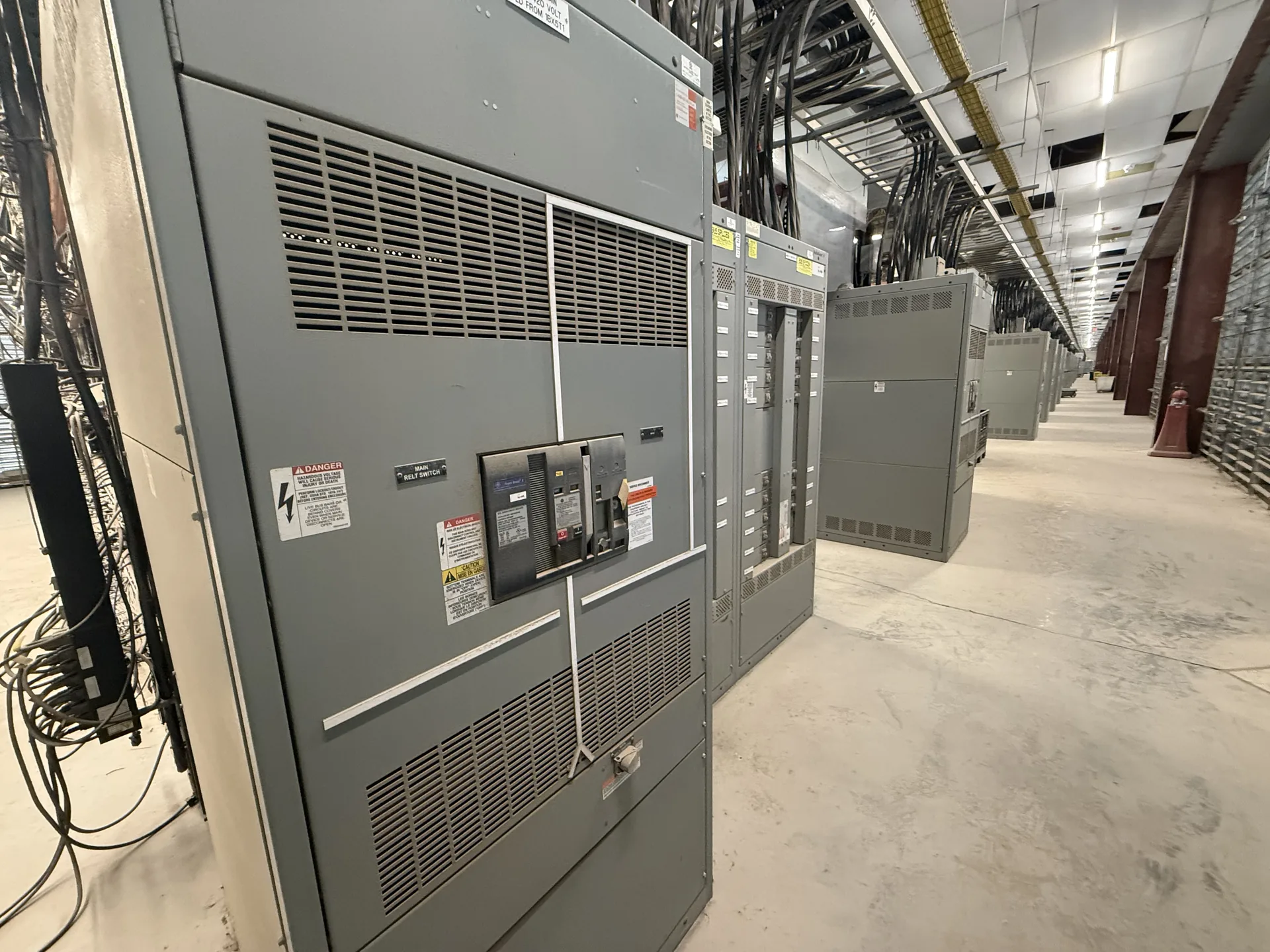
Power distribution, with purpose.
A switchgear package for a technology facility in Richardson should be planned around how the site responds to a power interruption—not simply around a voltage and ampere rating. For an illustrative project, the early work is to define which loads must remain available, how operators will see electrical conditions, and which controls must exchange signals with the facility system. The guidance below is a planning framework, not a claim of a local office, completed project, or guaranteed service territory. Confirm parcel-specific jurisdiction, utility requirements, and manufacturer capabilities before specifying or ordering equipment.
Start with continuity requirements, not a generic backup assumption
Technology sites can combine servers, network equipment, cooling, fire and life-safety systems, security, and ordinary building loads, each with different consequences if power is lost. The owner and design team should identify the loads that must be served, the acceptable interruption for each group, and the intended source sequence. A switchboard or switchgear lineup distributes and protects power; it does not by itself guarantee continuity. Generator controls, automatic transfer equipment, UPS systems, protective devices, and operating procedures must be considered as a coordinated system.
For the illustrative Richardson project, document normal and alternate sources, whether sources may operate in parallel, and how a failed source or bus section affects critical loads. Clarify whether maintenance requires a section to be isolated while other sections remain energized, and whether future capacity or a second utility feed is a design objective rather than an assumed availability. Those decisions can change the lineup arrangement, bus configuration, protective-device selection, and space requirements. Have the electrical engineer establish the one-line diagram and operating intent before requesting a firm equipment configuration.
Build a useful project-intake package
A quote request is more actionable when it includes the latest one-line diagram, equipment schedule, applicable specifications, and project stage. Supply the system nominal voltage and grounding arrangement, frequency, required continuous current, available fault-current information, and the desired short-circuit rating or method for determining it. Include source and feeder details, main and branch device requirements, bus arrangement, enclosure and environmental conditions, installation setting, and any known dimensional or access limits. Ratings must be matched to the actual system; nominal voltage is not the same as an equipment maximum rating.
For a continuity-focused facility, also identify which loads are critical, how sources transfer, what metering is expected, and which communication or hardwired control interfaces are specified. Mark unresolved items instead of treating assumptions as approved requirements. Provide applicable drawings and specifications in their current revision, the needed delivery window as a planning target, and the project location for freight coordination. The manufacturer can then review whether a custom new-equipment build is a fit, identify missing engineering inputs, and return questions through the agreed estimator or engineering handoff.


Confirm Richardson jurisdiction and utility conditions by parcel
A Richardson mailing address alone does not establish which authority reviews a particular electrical scope or which utility serves the parcel. Before publication or project release, verify the site boundary and permitting jurisdiction with official City of Richardson resources, then confirm current permit submittal requirements and inspection responsibilities for the actual scope. Do not rely on a nearby project, postal address, or an old permit record as proof that the same rules apply. Confirm whether separate reviews or approvals are needed for building work, electrical work, fire systems, or other associated scopes.
Identify the serving electric utility for the exact parcel and request its current service, metering, fault-current, and interconnection requirements as applicable. Confirm service voltage, available fault duty, transformer and service arrangements, and any restrictions affecting customer-owned generation or parallel operation directly with the utility and project engineer. These facts influence switchgear ratings and controls and may change during design. Utility approval should not be inferred from a manufacturer quote; record the responsible contact, document revision, and open questions in the project file.
Specify monitoring that helps operators make decisions
Monitoring should answer operational questions, not merely populate a communications point list. Decide which sources, mains, ties, and critical feeders need current, voltage, power, energy, demand, frequency, or power-quality information, and whether event records or alarms are required. Establish where readings will be viewed, who owns the data network, and whether operators need local indication if the building management or supervisory system is unavailable. Metering locations matter: measurements at a main device do not necessarily describe each downstream critical load.
The specification should state required protocols, addressing and network architecture, time synchronization, alarm priorities, and the division of responsibility for gateways, cabling, programming, and system integration. Clarify whether the electrical equipment supplier is furnishing meters and control devices, providing communication-ready components, or only preparing interface terminals. Compatibility must be checked against the actual devices and the facility’s controls platform; a protocol name alone does not establish an interoperable, commissioned system. Keep cybersecurity, network segmentation, and owner approval in the design review.
Resolve controls and protection tradeoffs before release
Source transfer, generator status, load shedding, and bus-tie logic can create important dependencies. The design team should define which device initiates each action, what permissives or interlocks apply, how an operator can recognize a blocked transfer, and what happens when a control signal or communications link is lost. Protection coordination and arc-flash analysis also depend on the final source and device data. A control sequence should not silently override protective functions, and a communications failure should not be assumed to produce a safe or desired operating state without documented design review.
More measurement points and control flexibility can improve visibility, but they add components, wiring, integration work, testing, and maintenance obligations. Conversely, a minimal design can leave operators without enough information to diagnose an abnormal condition. Review which functions belong in protective relays, which belong in transfer or generator controls, and which are supervisory indications. Confirm control power, terminal blocks, wiring diagrams, device settings responsibilities, and factory or field test expectations in the specification. Any proposed arrangement remains subject to engineering review and component availability.
Make the quote-to-delivery handoff explicit
After intake, assign an owner for technical questions, drawing review, utility comments, and specification changes. The purchaser should identify who can approve deviations, who will issue the final one-line and control narrative, and which drawing revision governs procurement. A quote is not a substitute for a coordinated design or utility acceptance. Before release, reconcile the equipment schedule against ratings, device functions, metering points, communications interfaces, physical arrangement, and required submittals so that late changes do not create avoidable schedule or integration risk.
A U.S. manufacturer can develop custom new equipment using American components and can make shorter lead time a goal, but availability, origin requirements, standards, and schedule must be confirmed for the specific order. UL 891 applies to low-voltage switchboards where applicable; it is not a general listing for medium-voltage gear, and no particular assembly’s status should be assumed. Arrange freight delivery details for the Richardson parcel, including receiving access, unloading responsibility, storage conditions, and the date the site can accept the lineup. Keep delivery, installation, and commissioning responsibilities distinct and verify each with the parties assigned to the project.
Specifications & planning
Review the details that matter for your application. Final specifications and availability should be confirmed for your project.
| Evaluation factor | Information to confirm |
|---|---|
| Continuity objective | Critical loads, allowable interruption, and source sequence |
| Electrical basis | Nominal voltage, grounding, fault-current data, and required ratings |
| Monitoring and controls | Measurements, protocol, signal ownership, and integration scope |
| Site and delivery | Parcel jurisdiction, serving utility, access, receiving, and target date |