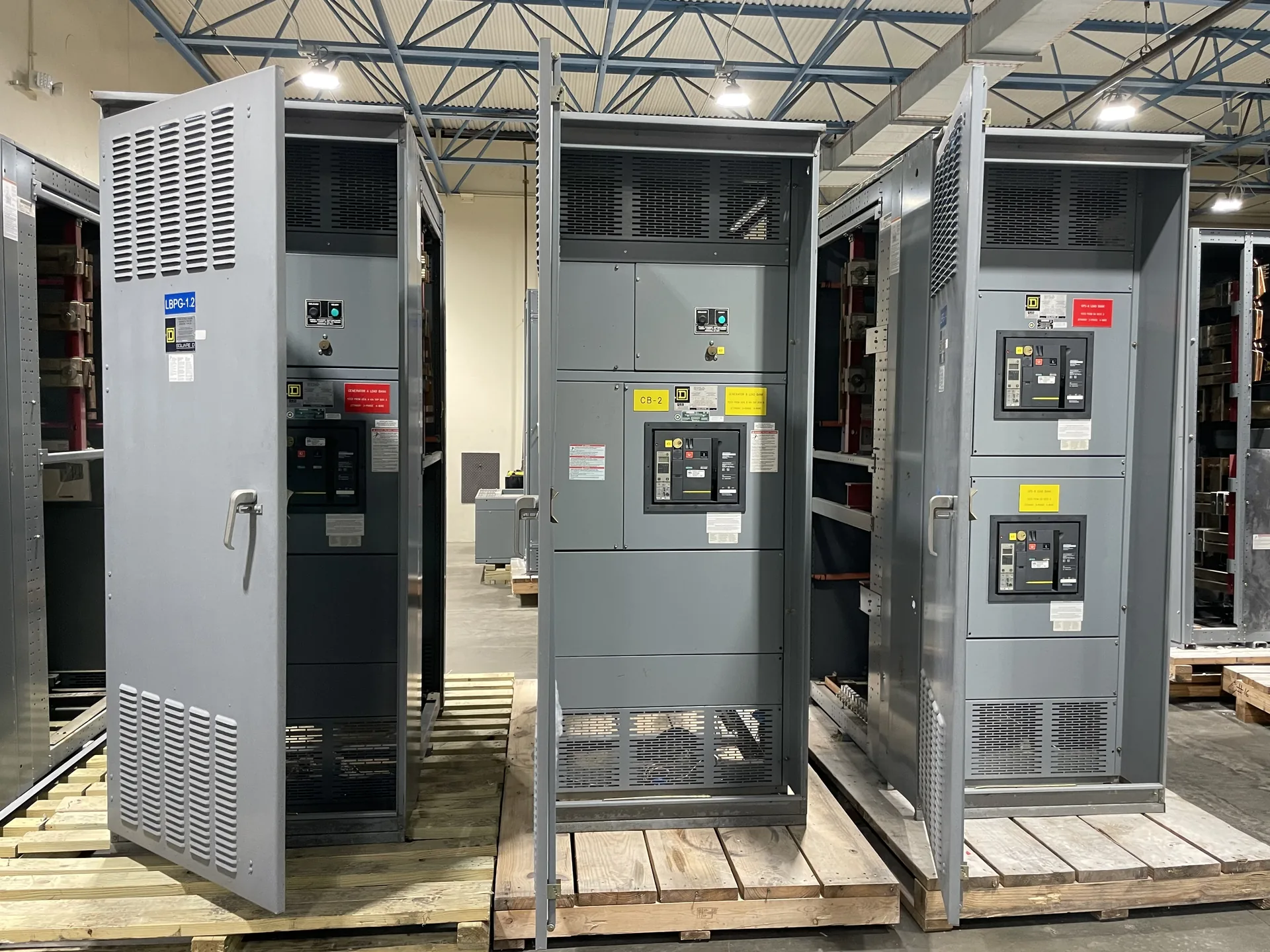
Power distribution, with purpose.
Flood exposure is not a cosmetic issue for electrical distribution equipment. Water, sediment, salt, chemicals, and prolonged humidity can affect insulation, bus joints, mechanisms, controls, and protective devices even after surfaces appear dry. A return-to-service decision should be based on the equipment’s actual exposure and documented condition—not on whether it can be switched on. This guide outlines evidence to collect and design records to preserve so qualified electrical professionals can assess the specific installation.
Establish the exposure before judging condition
Start with an event record tied to the equipment identification and location. Capture the highest known water level relative to the lineup, duration of inundation, whether water was fresh, brackish, or contaminated, and whether the enclosure was energized during the event. Record visible sediment, corrosion, debris, and signs of water entry through cable openings, ventilation, doors, or connected raceways. Photographs should show nameplates and affected areas without requiring anyone to approach equipment that may be unsafe.
The same flood depth can lead to different outcomes depending on construction and interfaces. Water may reach lower compartments, instrument transformers, control wiring, or insulating supports while leaving upper bus sections apparently untouched. Contamination and capillary movement can carry moisture beyond the visible waterline. Note connected transformers, cables, generators, and downstream equipment too; their condition may influence the safety and scope of an assessment. Do not energize equipment to test it before qualified personnel establish appropriate precautions.
Use records that identify the actual assembly
Gather the latest approved one-line diagram, equipment arrangement and compartment drawings, wiring and elementary diagrams, nameplate data, bill of materials, and protective-device information. Include the system nominal voltage, equipment ratings, available fault-current study, grounding arrangement, cable entry locations, and any documented modifications. These records help an engineer map the exposure to specific barriers, bus connections, control circuits, and interfaces instead of treating the entire lineup as an undifferentiated enclosure.
Preserve commissioning reports, inspection and maintenance history, prior test results, settings files, trip records, and records of replaced components. Identify drawing revisions and distinguish approved as-built documents from preliminary plans. If records are incomplete, mark uncertainty rather than assuming the installed configuration matches the original submittal. For a new custom switchboard or switchgear quote, supply the one-line, system and fault-current data, indoor or outdoor conditions, required sections and devices, cable terminations, control interfaces, and applicable project specifications. Final ratings and component availability require project-specific confirmation.


Make the decision through qualified assessment
Inspection, cleaning, testing, repair, replacement, and return-to-service decisions belong with qualified electrical professionals following applicable manufacturer guidance, safety requirements, and authority interpretation. A visual inspection alone cannot establish dielectric integrity, reliable operation, or suitability for service. The assessment may need to consider insulation condition, corrosion at current-carrying joints, mechanical operation, contamination in protected compartments, control-circuit behavior, and the condition of connected equipment. Work practices and any required test methods must be selected for the specific assembly and its condition.
A hypothetical example illustrates the judgment involved: a low-voltage lineup has floodwater documented below the main bus but above the bottoms of cable compartments, with sediment near feeder terminations and no reliable record of how long water remained. The apparent waterline does not prove the bus is unaffected, nor does it prove the lineup must be discarded. An engineer could use compartment drawings, inspection findings, contamination analysis, component guidance, and test evidence to define whether affected sections can be evaluated or replacement is the prudent path. This example is not a service determination or a claim about any actual installation.
Compare repair, replacement, and design choices
The practical options are not simply “dry it” or “replace everything.” Depending on documented condition and professional evaluation, a project may consider replacing affected devices or sections, rebuilding an assembly where permitted by its design and applicable requirements, or replacing the lineup to restore a known configuration. Repair can preserve interfaces and reduce redesign, but may leave uncertainty or create coordination challenges if obsolete components are involved. Replacement can provide a clearer lifecycle baseline, while introducing lead-time, outage, cable-fit, and coordination work that must be planned.
For a replacement design, compare compartment segregation, service access, control-power arrangement, cable routing, and provisions for future inspection—not just footprint and initial cost. Elevating vulnerable components or changing cable-entry details may reduce exposure in a future event, but cannot make equipment floodproof unless the complete installation and exposure are engineered for that purpose. Enclosure type, drainage, environmental conditions, and connected raceways all matter. A manufacturer can build new custom equipment and can work toward shorter lead times, but schedule, American-component requirements, ratings, standards, and any required UL 891 applicability must be confirmed for the specific order.
Preserve lifecycle evidence after the event
The final condition record should connect the event, evaluation, corrective work, and operating decision. Retain dated photographs, exposure estimates, inspection findings, test reports, replaced-part details, approved drawings, revised settings, and written limitations or recommendations from responsible professionals. Record what could not be verified as clearly as what was confirmed. This evidence helps future maintenance personnel understand why components were retained or replaced and prevents an uncertain assumption from becoming accepted operating history.
Update the maintenance plan to reflect the assessment, manufacturer recommendations, environmental conditions, and applicable standards, with intervals and procedures determined by qualified professionals. Keep configuration and settings records controlled so later changes can be traced. For a facility in Dallas–Fort Worth or elsewhere, local permitting, utility coordination, and code interpretation remain project-specific; service location does not change the need for competent assessment. The conclusion is limited to the evidence and scope reviewed, and it does not guarantee future performance, establish universal flood suitability, or substitute for an inspection by the responsible professionals.
Specifications & planning
Review the details that matter for your application. Final specifications and availability should be confirmed for your project.
| Evaluation factor | Evidence to collect |
|---|---|
| Water exposure | Depth, duration, water type, entry paths, and event photographs |
| Assembly configuration | Current one-line, nameplate data, compartment and wiring drawings |
| Condition evidence | Inspection findings, test reports, contamination, corrosion, and component history |
| Decision record | Qualified review, corrective work, limitations, and revised maintenance documentation |