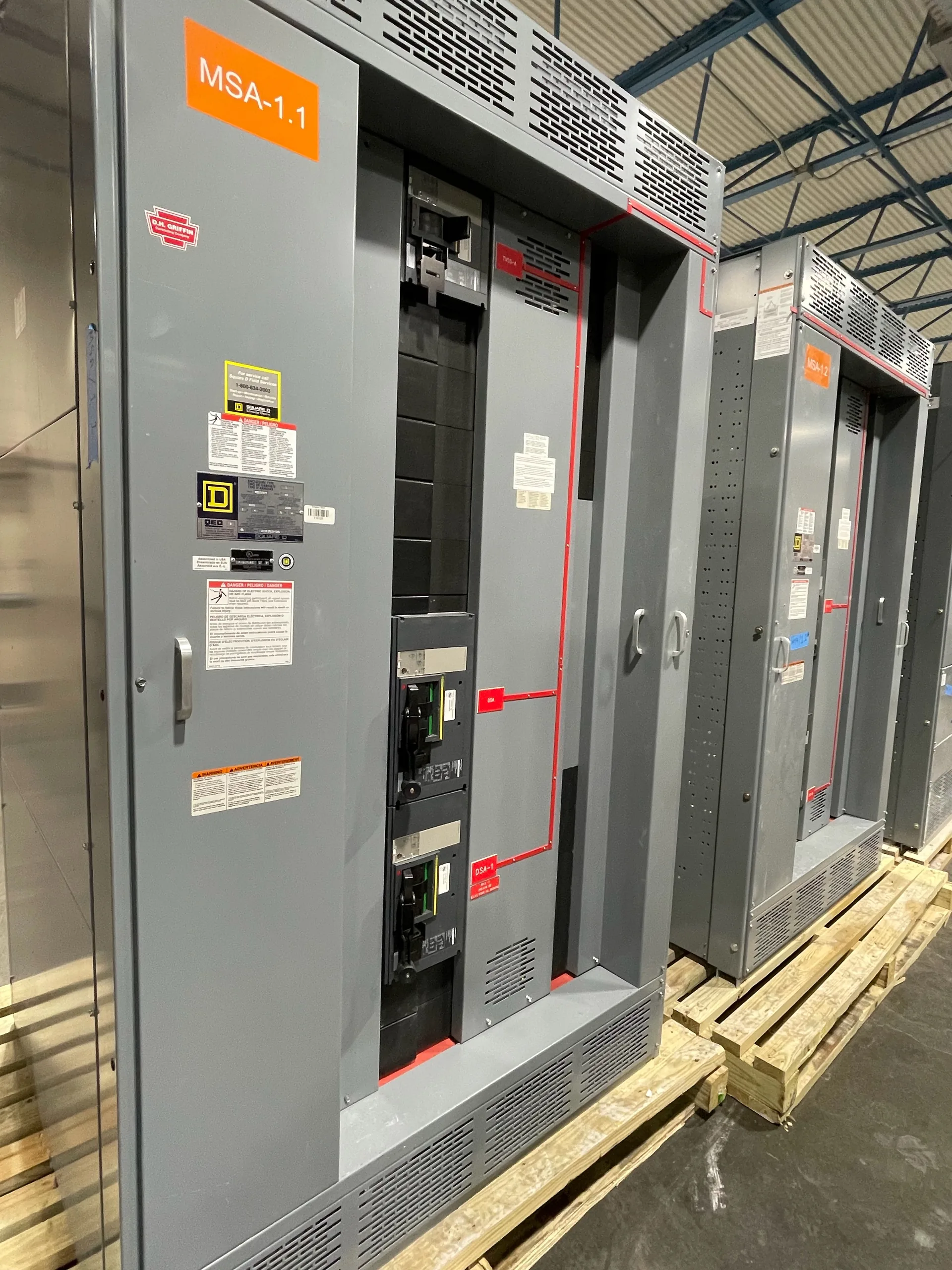
Power distribution, with purpose.
A customer-specified circuit breaker can affect more than the device installed in a switchboard. Its electrical ratings, physical envelope, trip unit, control interfaces and certification documentation all have to align with the assembly being designed. Before accepting a specified breaker for a new custom build, establish who supplies it, who verifies compatibility, and what documentation will govern the finished equipment. These checks help purchasers compare options and reduce avoidable redesign, schedule uncertainty and scope disputes.
Start with the complete electrical specification
Identify the breaker manufacturer and exact catalog or model number, including frame, poles, trip unit and accessories. Confirm the system nominal voltage and the breaker’s applicable voltage rating as separate facts; nominal system voltage alone does not establish that the device is suitable. The review also needs continuous-current requirements, interrupting or short-circuit ratings at the intended voltage, frequency, available fault current and any required coordination or protection settings. A rating that looks adequate in a product summary may depend on a specific configuration or upstream protective device.
Share the one-line diagram, system study information when available, project specification and the intended protective-device settings or coordination requirements. If the breaker is part of an existing electrical design, identify the upstream and downstream equipment that affect its application. Engineering review must confirm the proposed device against the specific assembly and system conditions; no single catalog value substitutes for that project-level check.
Verify mounting, bus and compartment interfaces
A breaker’s outline drawing is essential, but it is only one part of physical compatibility. The review should compare overall dimensions, mounting points, terminal orientation, required clearances, operating handle access, barriers and any drawout or racking features. Bus connections also require attention to conductor arrangement, phase spacing, terminal type, bending space and the mechanical support needed for the proposed connection. Even breakers with similar frame ratings can differ in dimensions and connection geometry.
Provide the manufacturer’s current dimensional and installation drawings, not just a photograph or a description such as “same frame size.” Note whether the requested configuration is fixed or drawout, and identify any special escutcheon, interlock, shutter or door provisions. If a customer-specified device requires changes to the compartment or assembly layout, those changes can affect enclosure space, heat dissipation, barriers and review scope. Acceptance should follow engineering confirmation rather than assumed interchangeability.


Define control, indication and protection needs
List every required electrical and mechanical interface. Depending on the selected configuration, this can include shunt trip, undervoltage release, closing coil, motor operator, auxiliary contacts, position indication, alarm contacts or communications. For each function, identify control voltage, AC or DC supply, contact requirements, wiring termination and the intended interface with the switchboard control scheme. State whether the breaker’s trip unit must provide ground-fault protection, metering, communications or particular setting ranges.
These details affect control power, terminal blocks, wiring diagrams, door devices and interlocks. Confirm whether the specified accessories are compatible with the exact breaker and trip unit rather than assuming they can be added later. The project documents should distinguish customer-provided settings and signals from functions that the assembly design is expected to accommodate. Any control or protection requirement that remains undecided should be recorded as an open item, not silently treated as included.
Assign sourcing, documentation and schedule responsibility
A quote needs a clear supply boundary: will the purchaser furnish the breaker, or should it be included in the new-equipment scope if available? For a customer-furnished device, identify the responsible shipper, required delivery date, receiving condition, packaging and responsibility for missing accessories or damage. Confirm when the exact device configuration will be known. Late delivery or a model substitution can hold up layout release, assembly work or final documentation, so any proposed schedule should be treated as a planning target until parts and engineering requirements are confirmed.
For a useful review, provide the bill of material or purchase description, product data, dimensional drawing, wiring and terminal diagrams, accessory list, trip-unit information and applicable installation instructions. Supply revision dates and identify any deviations from the published configuration. If these materials are incomplete, the engineering review may need to remain conditional. A customer-specified breaker is not accepted solely because it arrives at the manufacturing stage; scope, fit and documentation still need to be resolved before its role in the assembly is finalized.
Review listing, standards and record outputs
A component’s certification or recognition does not by itself establish that the completed switchboard configuration meets every applicable requirement. Review the requested assembly standard, project specifications, breaker documentation and any conditions attached to the component’s use. UL 891 applies to low-voltage switchboards; it is not a general listing for medium-voltage or high-voltage switchgear. Whether a particular device can be incorporated while maintaining the required assembly status must be confirmed for the exact design and order, not assumed from a breaker label or prior application.
A defined review should leave a traceable record: an approved or unresolved device description, compatibility comments, required deviations, control-interface details and the drawing revisions used for the decision. Depending on scope, revised arrangement, wiring, schematic or bill-of-material documents may be needed. Confirm which documents are included in the order and who approves them. Ratings, short-circuit capability, component availability, standards compliance and any U.S.-origin requirements must all be verified for the specific configuration.
Prepare a quote package and define boundaries
For a quote, send the project one-line and specification, the exact breaker model and accessories, current manufacturer drawings, electrical and control requirements, desired quantities, delivery expectations and the planned supply responsibility. Include known system fault-current data and state whether the breaker is mandatory or whether an equivalent alternative may be evaluated. If the project serves a Dallas–Fort Worth facility, note the destination and any delivery constraints; service to that market does not imply a local manufacturing location or installation scope.
The resulting proposal should distinguish what is confirmed from what remains subject to engineering review, component availability or customer documentation. Custom builds and American components may be considered where applicable, while shorter lead time can be a goal rather than a guarantee. Do not treat an unverified integration as an established capability or promise a particular certification outcome. Final acceptance depends on the exact breaker, complete assembly design, project requirements and agreed division of responsibility.
Specifications & planning
Review the details that matter for your application. Final specifications and availability should be confirmed for your project.
| Evaluation factor | Information to confirm |
|---|---|
| Electrical suitability | System conditions, device ratings and protection requirements |
| Physical fit | Outline, mounting, terminals, clearances and compartment interface |
| Controls | Accessories, control power, signals and trip-unit functions |
| Responsibility | Device source, documentation, delivery timing and review scope |