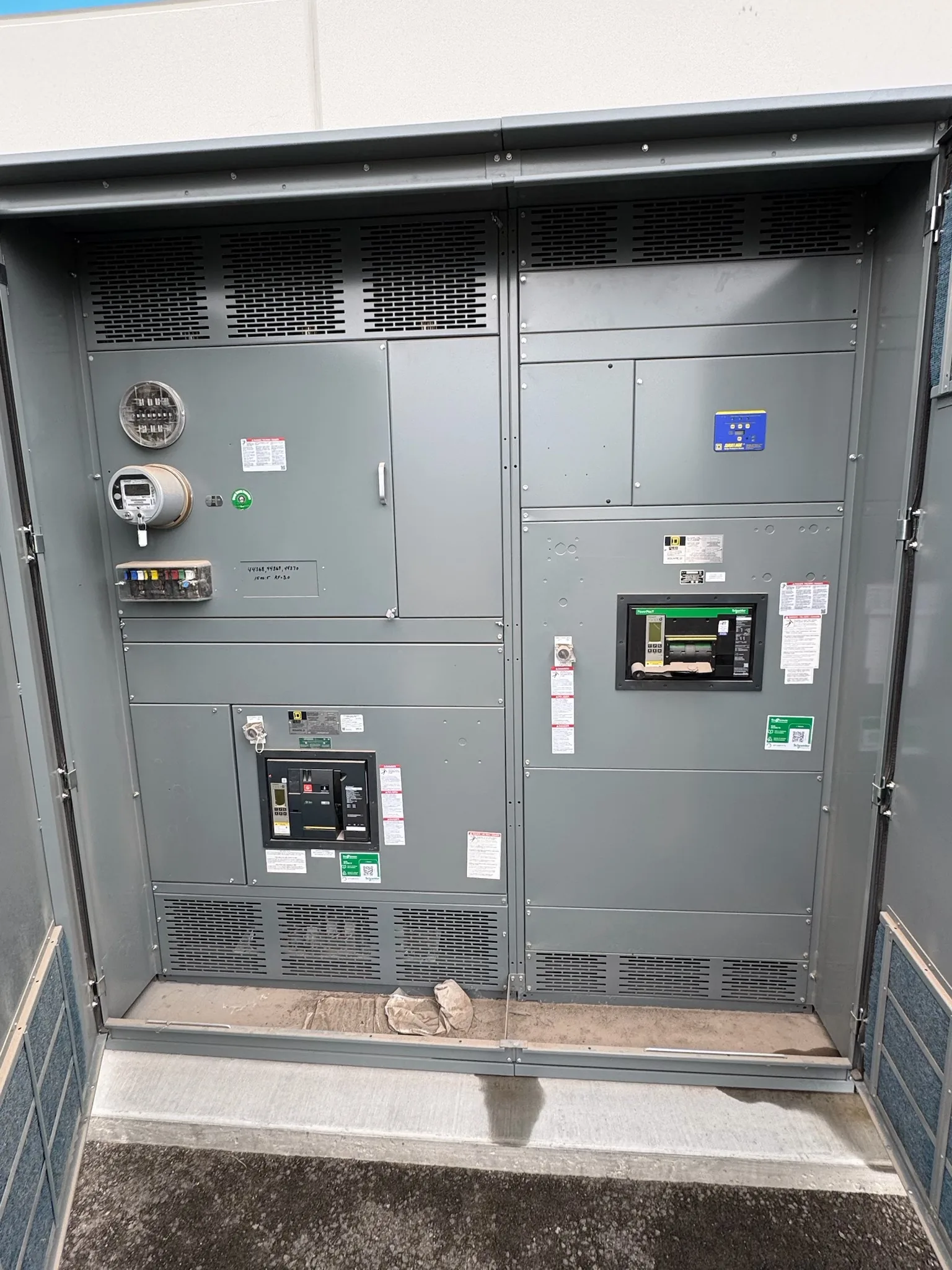
Power distribution, with purpose.
Choosing an industrial switchgear manufacturing company is a decision about engineering responsibility as much as equipment supply. Compare what each manufacturer will design, build, verify, and document against your project requirements, then identify which interfaces remain with your team or other suppliers. This helps prevent gaps between a technically sound assembly and a system that is ready to integrate.
Define the boundary of the manufacturer's work
Start by marking the physical and functional limits of the equipment package. A proposal may cover a switchboard or switchgear lineup but not upstream transformers, downstream distribution, protective relays, communications networks, field cabling, installation, or commissioning. Ask the manufacturer to state exactly which components and engineering deliverables are included, and which are excluded or supplied by others. Ambiguous boundaries can leave essential items unassigned until late in procurement.
Trace each important interface: incoming conductors, outgoing feeders, control power, grounding, metering, protective-device signals, and network connections. Confirm who supplies termination details, cable-entry provisions, interlocks, and interface drawings, and who checks compatibility with adjacent equipment. For a Dallas–Fort Worth project or a facility elsewhere in the country, geographic reach does not replace this coordination; drawings and responsibility assignments do.
Compare engineering depth, not just equipment descriptions
A short equipment description rarely shows how thoroughly a manufacturer has addressed the application. Compare the proposed one-line interpretation, equipment arrangement, device schedule, control logic, and assumptions about source and load conditions. Ask how changes to fault-current data, feeder counts, operating modes, or available space affect the design and quote. A manufacturer should be able to identify missing inputs rather than silently treating unknowns as settled.
Request a clear review path for submittal drawings and revisions. Establish which documents will be issued for approval, what information is needed to release the build, and how approved changes are handled. Check that the proposed engineering covers the intended operating sequence and protection interfaces, while recognizing that system studies, field verification, and settings coordination may belong to the owner or its engineering consultant unless explicitly included.


Check ratings against the actual system conditions
Compare electrical ratings as a coordinated set, not as isolated headline numbers. Provide the system nominal voltage and grounding arrangement, available fault current at the equipment location, required continuous current, frequency, and anticipated operating conditions. Ask the manufacturer to identify the equipment maximum rating separately from nominal system voltage and to explain the basis for the short-circuit rating and protective-device selections. The final suitability must be confirmed for the specific order and application.
For low-voltage switchboards, UL 891 may be relevant to the assembly; it is not a general listing for medium-voltage or high-voltage switchgear. Voltage class alone does not establish that a particular configuration meets a project requirement. Confirm the applicable standards, assembly status, components, and any owner or authority requirements in writing. Where the specification names a particular test, rating, or certification, resolve it before award rather than relying on broad marketing language.
Assess manufacturing scope and component accountability
Ask what the manufacturer actually builds and what it integrates from other suppliers. Compare responsibility for enclosure construction, bus design, breaker or fuse selection, control wiring, metering, relays, and customer-specified accessories. The answer affects drawing coordination, substitution control, and who resolves a mismatch between components. Request an itemized bill of material or equivalent equipment schedule at the appropriate procurement stage, with deviations identified for review.
New equipment can be configured around application requirements, but component availability and acceptable substitutions must be checked for the specific order. Ask how proposed alternatives affect ratings, dimensions, control interfaces, documentation, and service access. A shorter lead time may be a goal, not a guarantee: confirm the current schedule basis, approval milestones, and any long-lead components. American components or U.S.-origin requirements should be specified and verified at the component and order level, not assumed from a general statement.
Evaluate verification, records, and maintainability
Compare what each company will verify before shipment and what records it will provide. Clarify whether the scope includes routine checks, inspection records, wiring and nameplate documentation, final drawings, and manuals, and ask which tests or witnessed inspections require separate agreement. Do not assume that a quoted assembly has a particular listing, test report, or certification unless the manufacturer confirms it for the exact configuration.
Review maintainability in the proposed arrangement, including access to devices, space for cable terminations, labeling, and the ability to isolate equipment as the design intends. Ask for dimensions, weights, shipping splits, and handling constraints when they affect the receiving site or installation plan. Delivery planning is part of equipment selection: confirm packaging, destination assumptions, and unloading responsibility without treating shipment as installation or commissioning.
Prepare a quote package that supports a useful comparison
For a meaningful new-equipment quote, provide the latest one-line diagram, equipment schedule, project specification, system voltage and frequency, available fault-current information, load and feeder details, and the required controls and communications interfaces. Include site constraints such as indoor or outdoor service, environmental conditions, space limits, cable-entry direction, and shipping or access restrictions. Identify required standards, documentation, origin rules, and any preferred components, while distinguishing mandatory requirements from preferences.
Ask each manufacturer to return a defined scope, exceptions, assumptions, preliminary arrangement, rating basis, deliverables, and schedule milestones so proposals can be compared on the same terms. If information is not yet available, mark it as pending and ask what design decisions depend on it. That approach is useful whether a buyer is sourcing for a Dallas–Fort Worth facility or another U.S. location: it exposes engineering gaps early and keeps commercial comparisons tied to the equipment actually required.
Specifications & planning
Review the details that matter for your application. Final specifications and availability should be confirmed for your project.
| Evaluation factor | What to compare |
|---|---|
| Engineering boundary | Included equipment, interfaces, exclusions, and responsible parties |
| Rating basis | System conditions, equipment ratings, and order-specific confirmation |
| Build scope | Manufacturer-built work, integrated components, and substitution controls |
| Verification and delivery | Agreed records, shipment assumptions, and schedule milestones |