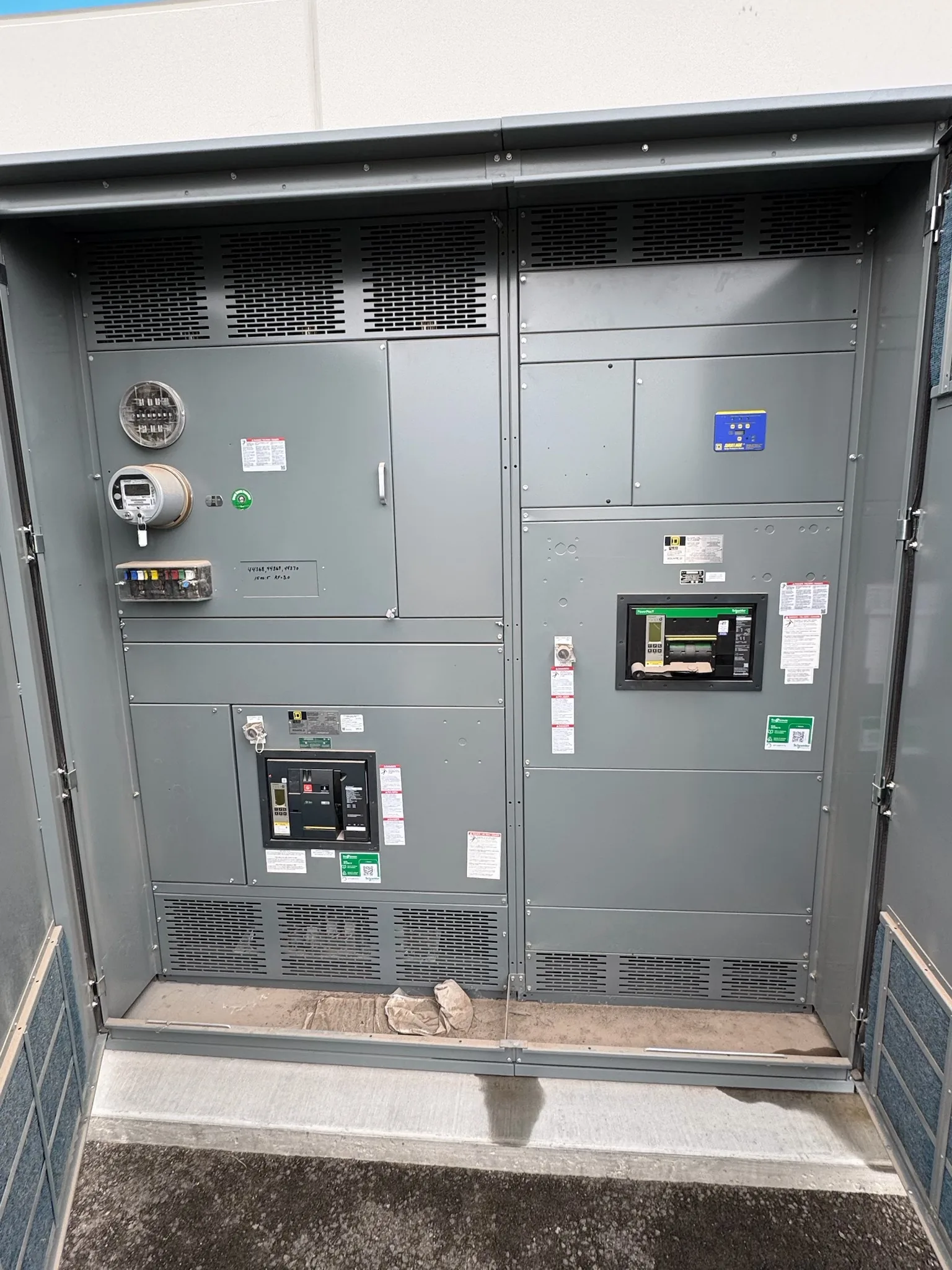
Power distribution, with purpose.
New-construction switchgear procurement works best when the buyer treats equipment selection as a coordinated design decision, not a late purchase order. The one-line diagram, utility requirements, building layout, permit schedule and construction sequence all affect what can be quoted and when. For projects in Dallas–Fort Worth or elsewhere in the United States, provide a complete, current design basis and identify open questions early. A manufacturer can build new custom equipment and use American components, subject to confirmation for the specific order; shorter lead time may be a goal, but availability and schedule must be verified against the approved design.
Set the electrical basis before requesting a quote
Start with the design documents that establish what the equipment must do: the latest one-line diagram, system nominal voltage, phase and wire configuration, frequency, bus arrangement, incoming and outgoing sources, and the loads or downstream equipment served. Identify whether the request is for a low-voltage switchboard, medium-voltage switchgear, or another assembly. Similar labels can refer to different equipment classes, so avoid relying on a project nickname or a preliminary equipment schedule alone.
Ask the engineer of record to define the required continuous current and short-circuit performance, including the available fault-current basis and protective-device coordination assumptions. Distinguish a system’s nominal voltage from an equipment maximum rating. Both the required ratings and the means of demonstrating them depend on the complete design and applicable standards. Do not assume that a rating, component, or standard treatment from another project transfers to this one; the manufacturer and project team must confirm details for the specific order.
Resolve utility, service, and protection interfaces
A new building’s service arrangement can still change while utility coordination is underway. Confirm the point of service, ownership boundary, metering requirements, transformer information, grounding method, available fault current, and any utility-specific drawing or submittal requirements. If a utility value is pending, mark it as pending rather than silently substituting an estimate. That distinction helps the engineer assess whether a change could affect bus ratings, protective devices, metering provisions, or enclosure layout.
Also define how the switchgear interfaces with generators, transfer equipment, photovoltaic or energy-storage systems, power monitoring, and downstream distribution, where applicable. State which functions are included in the equipment scope and which belong to other suppliers or the electrical contractor. Confirm control voltages, communication expectations, interlocking responsibilities, and terminal or conduit entry constraints with the responsible designers. Clear boundaries reduce the chance that a quote is compared against a different scope or that an interface is discovered only after submittal review.


Coordinate room geometry and construction access
Procurement drawings must reflect the actual electrical-room plan, not just the available wall length. Provide room dimensions, equipment orientation, working and service clearances established by the project design, ceiling and floor conditions, door openings, overhead obstructions, and planned cable or busway routes. Identify whether cables enter from above, below, or another direction, and where the contractor expects to land them. These details can affect section arrangement, enclosure dimensions, access, and the feasibility of moving the assembly into the building.
Compare the anticipated shipping configuration with the construction route from receiving area to final room. Ask the project team to confirm doorway and corridor constraints, elevator or lifting limits, floor-loading considerations, and the sequence for setting equipment. Do not assume that a drawing showing an assembled lineup proves that it can pass through the planned route. For a Dallas–Fort Worth project, as for any project, local site conditions and delivery arrangements must be checked by the project team; serving the region does not establish a factory or installation presence there.
Build permitting and submittal review into the schedule
Before release for manufacture, align the procurement schedule with the authority having jurisdiction’s review process, the engineer’s submittal review, utility approvals, and the construction milestone that depends on equipment. Ask who owns each approval and what documents are required. The project may need drawings, equipment data, wiring information, or other documentation, but the applicable submission set depends on the design and jurisdiction. Confirm required format, review duration assumptions, revision control, and the latest date for incorporating changes.
Treat approval status as a decision gate rather than a formality. Establish whether the purchase order authorizes engineering and drawing preparation only, or whether it also authorizes fabrication after specified approvals. Record unresolved items, responsible parties, and their effect on the release date. If a permit comment or utility revision changes the design after approval, have the engineer assess the technical and schedule implications before requesting a change. No lead time should be presented as guaranteed until configuration, components, approvals, and order conditions have been reviewed.
Compare bids on equivalent technical scope
A useful bid comparison checks more than the total price. Compare the proposed equipment type and lineup, included devices and metering, control and communication scope, enclosure and access assumptions, drawings and documentation, shipping configuration, exclusions, and the stated basis for ratings. Ask bidders to identify deviations from the project specification in a clear, reviewable form. A lower figure may reflect omitted accessories, different assumptions, or unresolved design work rather than an equivalent offer.
For low-voltage switchboards, ask whether a proposed assembly is intended to meet the project’s applicable UL 891 requirements and have that status confirmed for the specific configuration; UL 891 is not a general listing for medium- or high-voltage switchgear. Confirm all applicable standards, ratings, short-circuit performance, component availability, and any U.S.-origin requirements before award. A manufacturer’s ability to build custom equipment or use American components does not, by itself, establish a particular certification, component choice, or origin status.
Prepare a quote package and preserve decision ownership
To request a meaningful quote, provide the current specification, one-line diagram, equipment schedule, room and access drawings, utility criteria, fault-current information or its status, required standards, and target submittal and delivery milestones. Include the expected quantities, scope boundaries, preferred options, and a contact or process for technical clarifications without placing unresolved assumptions into the design. Identify the document revisions and list any known pending decisions. A manufacturer can then identify missing inputs and state what needs confirmation before a firm equipment configuration is established.
Keep design authority with the project’s qualified electrical professionals. The manufacturer can clarify its proposed equipment and review interfaces, but the engineer of record and other designated parties determine whether the selection meets the project design, code, permit, and utility requirements. Before purchase, document the accepted configuration, exceptions, approval conditions, and change process. This disciplined handoff helps the buyer manage design coordination and construction risk without mistaking a preliminary quote for an approved, fully defined installation.
Specifications & planning
Review the details that matter for your application. Final specifications and availability should be confirmed for your project.
| Evaluation factor | Buyer confirmation |
|---|---|
| Design basis | Current one-line, nominal voltage, system configuration, and engineer-defined ratings |
| Utility interface | Service, metering, fault-current basis, and open utility requirements |
| Physical fit | Room plan, clearances, cable entry, and verified delivery route |
| Approvals and scope | Submittal gates, applicable standards, documented deviations, and exclusions |