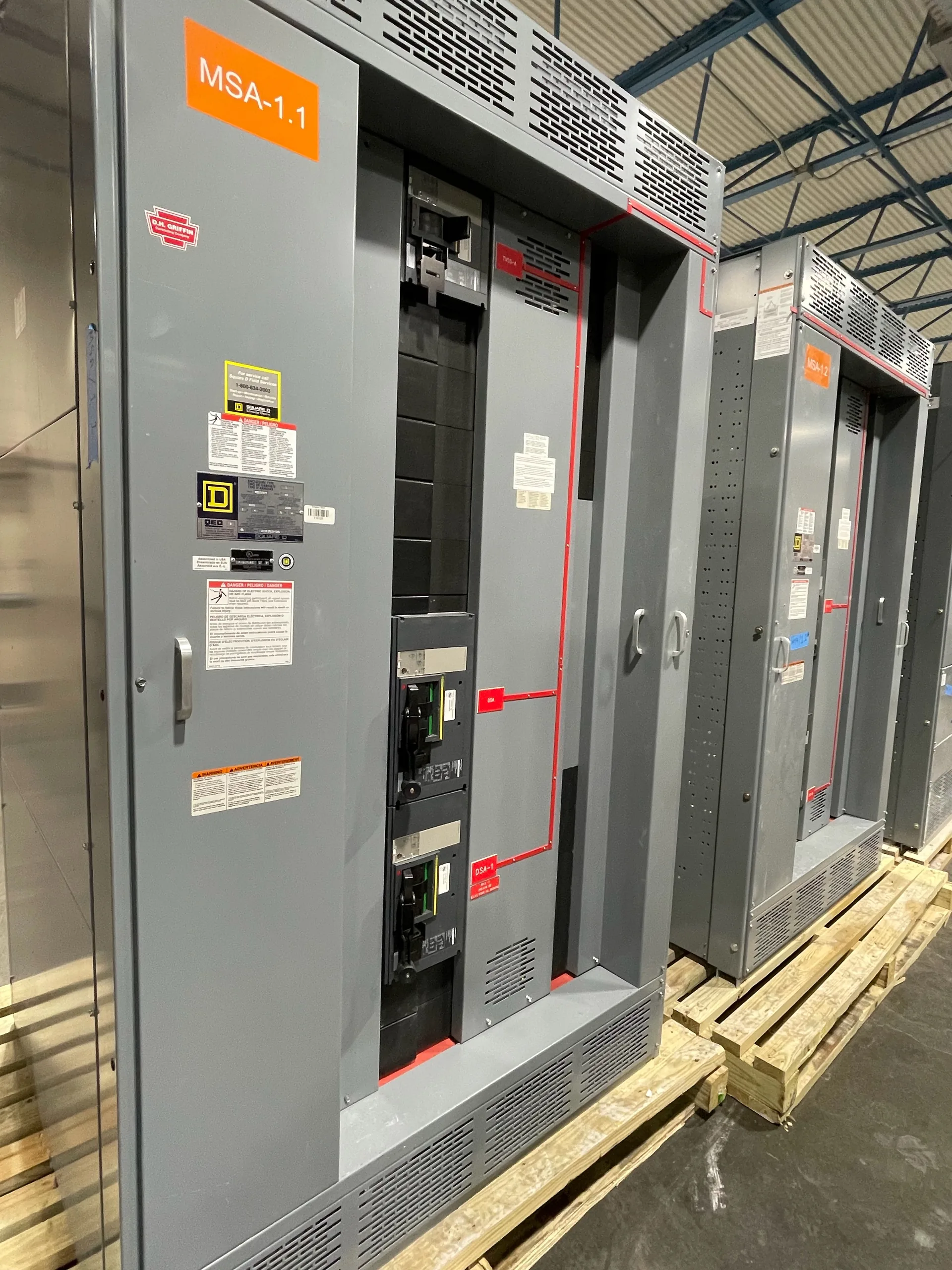
Power distribution, with purpose.
A multi-tenant industrial project in Lewisville needs more than a switchboard sized for today’s connected load. Metering boundaries, tenant turnover, future expansion, and the serving utility’s requirements all affect how the service and downstream distribution should be arranged. Use this planning guide to organize design decisions and prepare a useful request for a new-equipment quote. It does not imply a Lewisville office, a completed local installation, or guaranteed service coverage. Before design is finalized, verify the parcel’s jurisdiction, current permitting requirements, and applicable utility resources with the responsible authorities.
Establish the parcel, authority, and utility early
Start with the project’s exact street address or parcel identification, not just “Lewisville.” A site described by its mailing city may be subject to a different permitting authority or utility service arrangement than expected. Confirm the parcel’s jurisdiction and applicable electrical-permit process through official city or other responsible authority resources. Check current submittal requirements, review sequencing, and inspection responsibilities directly; requirements can vary with project scope and change over time.
Identify the electric utility serving the specific parcel and request its current service criteria before fixing the switchgear design. Confirm service voltage and configuration, point of delivery, metering rules, available fault-current information, utility-owned versus customer-owned equipment, and any required review of service equipment. Do not infer the applicable utility from a nearby property or rely on an old drawing. Utility confirmation can change the service entrance, metering compartment arrangement, protective-device selection, and space needed for utility access.
Define tenant metering and ownership boundaries
For multi-tenant industrial service, describe each tenant’s intended electrical boundary before selecting equipment. The design team should establish whether each space receives a separate utility meter, a landlord meter with tenant submeters, or another utility-approved arrangement. These are not interchangeable assumptions: utility rules, lease structure, billing responsibilities, and applicable code requirements may affect which configuration is acceptable. Record who owns, operates, and maintains each part of the service and distribution system.
Separate meters can support independent tenant accounts, but they may require distinct meter positions, service disconnects, and coordinated access. Submetering may simplify a shared service arrangement while creating different responsibilities for measurement and billing. Ask the utility and electrical engineer to confirm the permitted arrangement, metering equipment and compartment details, and clearances before procurement. A manufacturer can evaluate equipment against an approved one-line diagram and written requirements; it should not be asked to decide utility policy or establish tenant billing rules.


Size for present demand and credible growth
Gather connected-load schedules by tenant, including known motor loads, HVAC, process equipment, charging loads, and any planned common-area demand. Have the electrical engineer determine demand, diversity, service capacity, feeder requirements, and protection from the actual project data and applicable rules. A large nameplate total is not by itself a sound basis for selecting service equipment, and assumed diversity should be documented rather than used to hide uncertainty.
Expansion provisions work best when they address a defined pathway: anticipated additional tenants, spare feeder positions, future service growth, or planned equipment changes. Compare the cost and footprint of initial spare capacity with the constraints of a crowded electrical room and the possibility that future additions will require shutdowns or redesign. Specify what “expandable” means, such as reserved space, bus provisions, or a planned section interface, and have the engineer verify that the selected arrangement supports it. Do not assume future extensions are possible without confirming ratings, physical compatibility, and availability.
Resolve design interfaces and equipment tradeoffs
A quote package should make the service and distribution interfaces visible. Provide the current one-line diagram, service and system nominal voltage, phase and wire configuration, utility fault-current data, requested continuous-current and short-circuit ratings, and the proposed meter and disconnect arrangement. Include enclosure and room constraints, cable-entry direction, conductor information, access clearances, and any required communications or monitoring interfaces. These details help identify conflicts between the electrical design, utility compartments, structural openings, and tenant layouts before equipment is built.
For low-voltage distribution, a UL 891 switchboard may be applicable when the design and specified assembly support that standard; UL 891 is not a general designation for medium-voltage gear. State system nominal voltage separately from equipment maximum rating, and do not treat a voltage label alone as proof of suitability. Protection approach, service configuration, maintainability, footprint, and future feeder provisions all involve tradeoffs. Ratings, short-circuit capability, components, standards, and any U.S.-origin requirements must be confirmed for the specific order and design.
Prepare a complete quote and delivery handoff
For a useful quote review, send the project location and jurisdiction status, the latest engineer-issued one-line, load information, utility correspondence, meter requirements, requested ratings, equipment layout, and a target procurement schedule. Identify what remains unresolved instead of filling gaps with guesses. Include the expected shipment destination, receiving limitations, delivery access, unloading responsibility, and any restrictions on truck timing or site storage. These logistics matter for a large assembly even when equipment is shipped to a project in the Dallas–Fort Worth area.
The manufacturer can review the information, clarify equipment scope, and discuss a custom new build using American components where specified. Shorter lead time can be a goal, not a promise; actual schedule depends on design approval, component availability, and order details. A clean handoff connects the owner or contractor, electrical engineer, utility, permitting authority, and equipment supplier so revisions reach the right parties. Before release, obtain written confirmation of the approved drawings, metering interface, ratings, standards, origin requirements, and delivery scope.
Specifications & planning
Review the details that matter for your application. Final specifications and availability should be confirmed for your project.
| Evaluation factor | What to confirm |
|---|---|
| Jurisdiction | Parcel-specific permitting authority and current submittal process |
| Utility service | Serving utility, service configuration, fault-current data, and metering criteria |
| Tenant boundaries | Utility meters or approved submeter approach, disconnects, ownership, and access |
| Growth plan | Expected tenant loads, spare positions, expansion pathway, and room constraints |
| Quote handoff | One-line, ratings, approved interfaces, shipment destination, and receiving conditions |