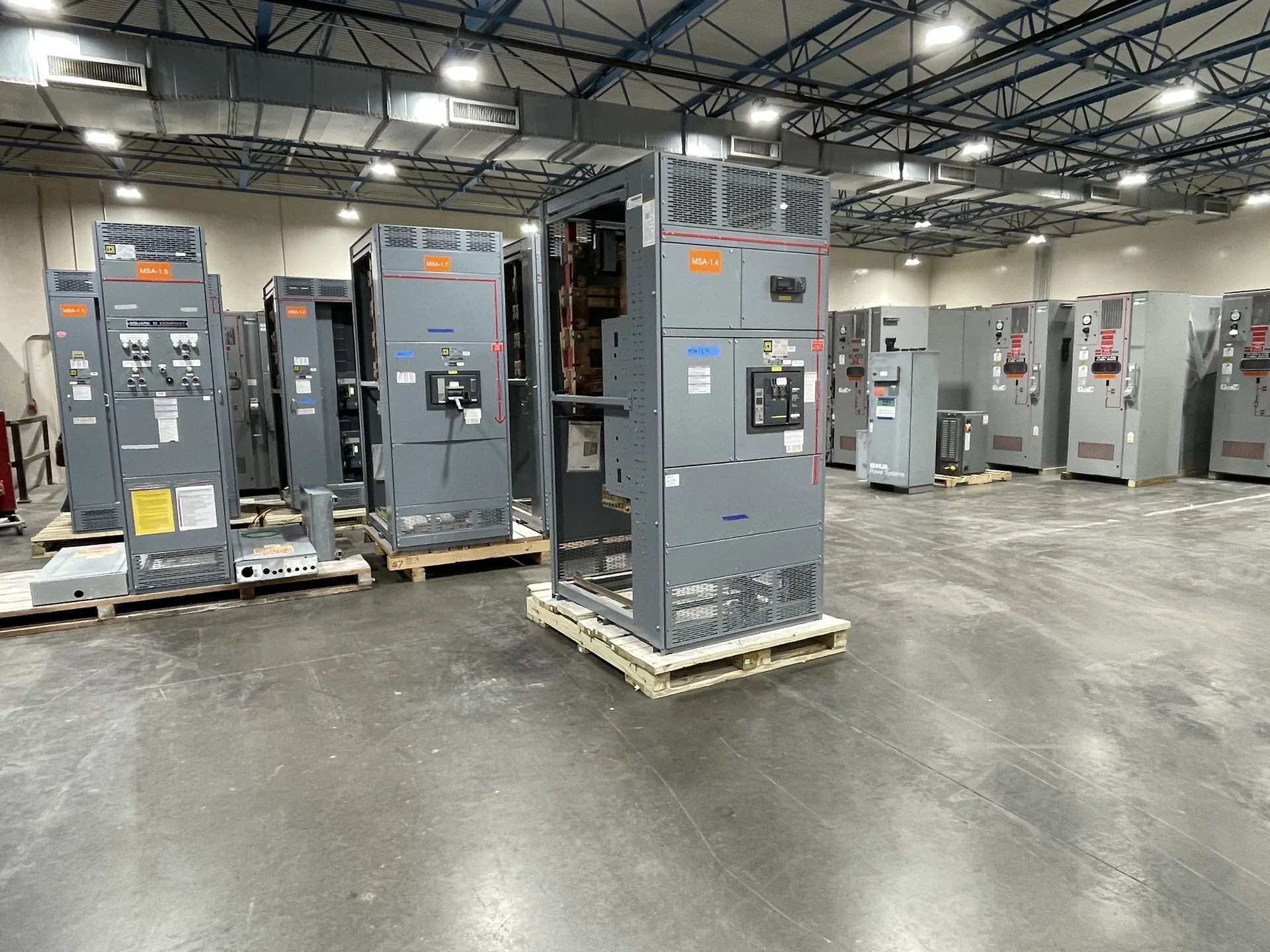
Power distribution, with purpose.
Switchgear and switchboards both distribute power and provide ways to isolate circuits, but the names do not describe interchangeable products. Their construction, protective devices, applicable standards and operating needs can differ substantially. Choosing between them requires looking beyond the label to the electrical system, fault conditions, operating plan and project specifications.
The distinction starts with construction
A switchboard is generally a low-voltage assembly of buses, protective devices, metering and related components arranged in one or more sections. Devices may be fixed-mounted or, depending on the design, drawout. Construction details such as barriers, compartmentation, access and the way sections connect affect how the assembly is installed and serviced. A switchboard is often selected for straightforward distribution where the specified ratings, arrangement and maintenance plan fit its construction.
Switchgear is a broader term for assemblies designed to switch, protect and isolate circuits, and it commonly refers to equipment with more separated compartments and withdrawable breakers in applications where those features are specified. Medium-voltage switchgear is a distinct class from low-voltage switchboards, with different insulation systems, operating mechanisms and standards. These are typical distinctions, not a universal hierarchy: the actual design and ratings matter more than the product name.
Standards and voltage class must match the equipment
For low-voltage assemblies, UL 891 applies to switchboards. It should not be treated as a general standard or listing for medium-voltage switchgear. Medium-voltage equipment has its own applicable standards and evaluation requirements, which depend on the equipment type and project specification. A system’s nominal voltage and the equipment’s maximum voltage rating are related but not identical; verify both rather than using a voltage label alone to determine suitability.
The project documents should identify the governing standards, required certifications or listings, service conditions and acceptance criteria. A manufacturer can confirm what applies to a particular proposed assembly, but a generic product description cannot establish that an order meets every project requirement. Short-circuit ratings, interrupting capabilities, component availability and any U.S.-origin requirements must also be confirmed for the specific configuration and order.


Protection and coordination drive the selection
The right assembly depends in part on how protective devices work together across the electrical system. Engineers review available fault current, device ratings, trip settings, selective coordination requirements and the consequences of an upstream or downstream trip. A switchboard may suit a distribution arrangement with the required protective devices and coordination, while another design may call for features associated with switchgear. Neither label guarantees a particular level of protection or coordination.
For example, consider a hypothetical facility with a utility service, a main distribution assembly and several downstream panels. If continuity of selected loads is important, the design team may compare breaker types, compartment arrangements, maintenance access and coordination results—not simply request “switchgear.” The example does not prescribe a solution: an engineer must evaluate the actual one-line diagram, utility fault data, load characteristics and applicable codes before selecting equipment or settings.
Maintenance and operation are part of the decision
Construction can influence how equipment is inspected, isolated and maintained. Fixed-mounted devices and withdrawable devices have different service considerations, and compartmentation affects access and the extent to which work on one part may require outages elsewhere. These features can affect maintenance planning, but they do not eliminate the need for safe work practices, qualified personnel, manufacturer instructions and an appropriate outage or risk-management plan.
Compare the expected switching frequency, available outage windows, staff qualifications, spare-parts strategy and facility consequences of downtime. A more compartmentalized arrangement may be justified by the operating plan, while a simpler assembly may meet the need with less complexity. Cost, footprint and delivery considerations should be weighed against functional requirements; none should be assumed from the word “switchgear” or “switchboard” alone.
Specify the interfaces before requesting a quote
A useful quote request includes the one-line diagram, nominal system voltage, frequency, phase and wire configuration, main and feeder requirements, load information, available fault-current data and required short-circuit ratings. Include the intended installation environment, dimensions or layout constraints, cable entry and termination details, metering and control needs, communication interfaces, preferred protective-device types and any specified standards or listing requirements. Identify coordination, arc-flash or other engineering studies that govern the design.
Also provide project location and schedule needs, shipping constraints, required documentation, spare-device expectations and any domestic-content or component-origin requirements. For a Dallas–Fort Worth project, location can inform delivery planning, but it does not establish where equipment is manufactured or installed. The manufacturer builds and supplies new equipment, including custom configurations; proposed components, ratings, standards compliance and lead time must be confirmed for the specific order.
Engage a qualified professional when requirements are unclear
A qualified electrical engineer or other responsible design professional should resolve uncertainties about fault-current calculations, protective-device coordination, equipment ratings, grounding, code requirements and the fit between the assembly and the facility. This is especially important when replacing existing equipment, changing service capacity, integrating generators or other sources, or working with incomplete drawings. A supplier can clarify product configuration and manufacturing details, but should not be treated as a substitute for project engineering.
Before purchase, ask the project team and manufacturer to reconcile the specification, drawings and equipment submittal, including interfaces with transformers, conductors, controls and downstream distribution. Confirm that the selected construction supports the intended operating and maintenance plan and that all ratings and compliance requirements are documented for the order. The practical answer to “switchgear or switchboard?” is therefore the assembly that satisfies the engineered application—not a presumed ranking between the two.
Specifications & planning
Review the details that matter for your application. Final specifications and availability should be confirmed for your project.
| Evaluation factor | What to verify |
|---|---|
| Equipment class | Low-voltage switchboard or applicable switchgear class; confirm nominal voltage and maximum equipment rating |
| Protection | Available fault current, device ratings and coordination requirements established by project engineering |
| Construction | Fixed or withdrawable devices, compartmentation, access and section arrangement |
| Project fit | Applicable standards, interfaces, environment, maintenance plan and order-specific component availability |