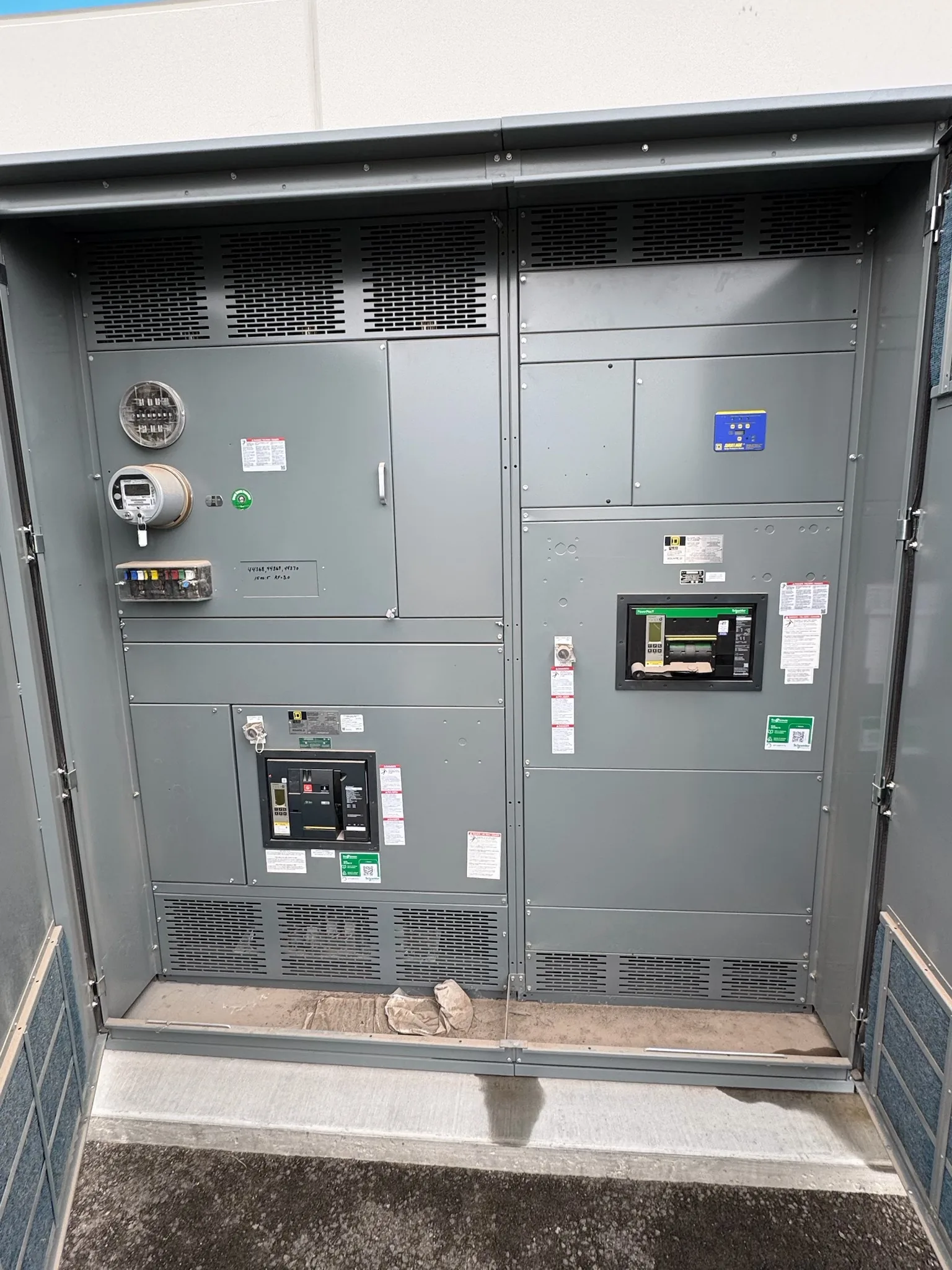
Power distribution, with purpose.
A SCADA point list is the agreement between electrical equipment and the control system about what can be observed, commanded and trusted. For a specific distribution design, it should identify each signal’s source, meaning, interface, normal state and behavior when power or communications fail. Treat it as an engineering document, not a generic catalog of breaker points: an ambiguous “breaker status” can conceal whether the indication comes from auxiliary contacts, a networked trip unit or a derived logic state.
Start with the one-line and operating states
Build the list from the current one-line diagram and the intended operating modes. Identify each source, tie, feeder and bus section, then determine which states operators need to distinguish: breaker open or closed, disconnect position where monitored, local or remote control selection, protective relay alarm, trip, and loss of control power. A normally open tie and a source breaker that is open for maintenance may both read “open,” but their operational meaning differs. Use point names and descriptions that identify the device and state rather than relying on a screen symbol alone.
The design input should also state the permitted switching sequence and any interlocks affecting remote commands. A point list cannot establish whether a transfer is safe or define protection settings by itself. Those decisions depend on the system study, equipment arrangement and operating procedures. For a Dallas–Fort Worth facility or a site elsewhere, the same discipline applies: document the actual source configuration and utility interface instead of assuming a standard arrangement.
Define each point at its source
For every point, record the device tag, point name, data type, units or state text, source component, and whether the value is measured, directly indicated or derived. Voltage, current, frequency, demand and energy values need a defined measurement source and scaling basis. Breaker position should specify the contact or device status used, including whether a discrepancy between auxiliary contacts is detected. A derived “available source” point should disclose its logic inputs; it must not be presented as a direct physical measurement.
Decide which information is essential for operation and which is useful for trending or maintenance. Alarm, trip and protection-target indications may warrant distinct points rather than one broad alarm bit. Define alarm priority, deadband, time stamping and event retention with the SCADA integrator and owner. Where a relay or trip unit provides data over a protocol, confirm the actual register map, firmware and supported functions for the specified component; do not assume every measurement or event is exposed.


Separate hardwired logic from communications
Hardwired contacts can provide direct status or permissive signals, while a communications link may carry richer metering, diagnostics and event data. Choose the interface point by point, considering required response, isolation, wiring distance, maintainability and the consequence of losing the signal. A hardwired indication can remain available when a network path is down, but it consumes terminals and conductors and still depends on the contact, wiring and control-power design. Communications can reduce point-to-point wiring, but adds dependence on compatible devices, network configuration and data mapping.
Remote open and close commands need particular care. Specify command source, local/remote authority, permissive and interlock handling, command pulse or maintained behavior, and positive indication of command acceptance and resulting device state. A SCADA command should not bypass protective functions or equipment interlocks. The control narrative and electrical drawings must agree on whether logic resides in a relay, switchboard controller, PLC or supervisory system. Final control logic and work practices belong with qualified professionals.
Make failure behavior explicit
For each communications-derived point, define what the operator sees when data becomes stale, a device stops responding or a gateway loses its upstream connection. “Zero” is not a safe substitute for “unknown”: a zero-current value may be valid while a disconnected meter is not reporting. Use an explicit quality or communication-failure indication, specify stale-data timing for engineering review, and define whether the last value remains visible as stale or is suppressed. Document how alarms distinguish equipment conditions from telemetry failure.
Also consider loss of control power, failed auxiliary contacts, contradictory position indications and loss of the SCADA host. A command timeout should not be interpreted as proof that a breaker changed state; the design should require independent position feedback or otherwise make uncertainty clear. Redundant paths may improve availability, but they add components and configuration that must be tested. The appropriate behavior depends on the consequences of lost visibility or control, not on a universal point-list template.
Use a worked hypothetical to resolve a design choice
Consider a hypothetical lineup with two incoming sources, a bus tie and feeder breakers. The owner wants source voltage and frequency, feeder current, breaker position, trip indication and remote operation. One option is hardwired contacts for critical breaker states and commands, with protocol data for metering and diagnostics. Another is to carry both state and measurement data over the device network. The first may preserve selected indications through a network outage but requires more wiring; the second may simplify wiring while making those points dependent on device and network availability.
The choice turns on the operating requirement, not a preference for one technology. If operators must retain breaker-position visibility during a network failure, the design team might specify independent hardwired status for selected devices and networked metering, subject to review of the actual equipment and control-power scheme. The point list should then state which indication is authoritative, how disagreement is alarmed, and what the operator can still command. This example is hypothetical and does not establish a recommended architecture for a particular facility.
Issue a coordinated, reviewable point list
A useful quote and design package includes the one-line, equipment schedule, control schematic, sequence of operation, preferred communications protocol, SCADA or PLC interface requirements, naming convention and required point quantities by device. Supply the owner’s alarm philosophy, network and cybersecurity requirements, time synchronization method, environmental conditions, desired metering, command permissions and any required test documentation. Identify who provides gateways, network switches, programming and integration; these boundaries can materially change scope. A manufacturer can then assess a custom new-equipment build and component compatibility rather than infer interfaces from a broad request.
Review the point list against elementary and wiring diagrams, terminal plans, relay settings documents, communications maps and final equipment records. Confirm point polarity, scaling, units, tag consistency and failure states before factory or site acceptance testing is planned. A low-voltage switchboard assembly may be designed for UL 891 where applicable, but that does not establish SCADA functionality or apply that standard to medium-voltage gear. Equipment ratings, short-circuit ratings, available components, standards, and any U.S.-origin requirements must be confirmed for the specific order. The point list’s conclusions remain limited to its documented design and should be approved by qualified electrical and controls professionals.
Specifications & planning
Review the details that matter for your application. Final specifications and availability should be confirmed for your project.
| Evaluation factor | Example specification decision, subject to engineering review |
|---|---|
| Point meaning | Direct contact status, network value, or explicitly identified derived state |
| Data quality | Define stale, invalid, substituted, and communication-failure indications |
| Command behavior | Document authority, interlocks, acceptance feedback, and position confirmation |
| Interface scope | Identify protocol, device map, gateway responsibility, and required records |