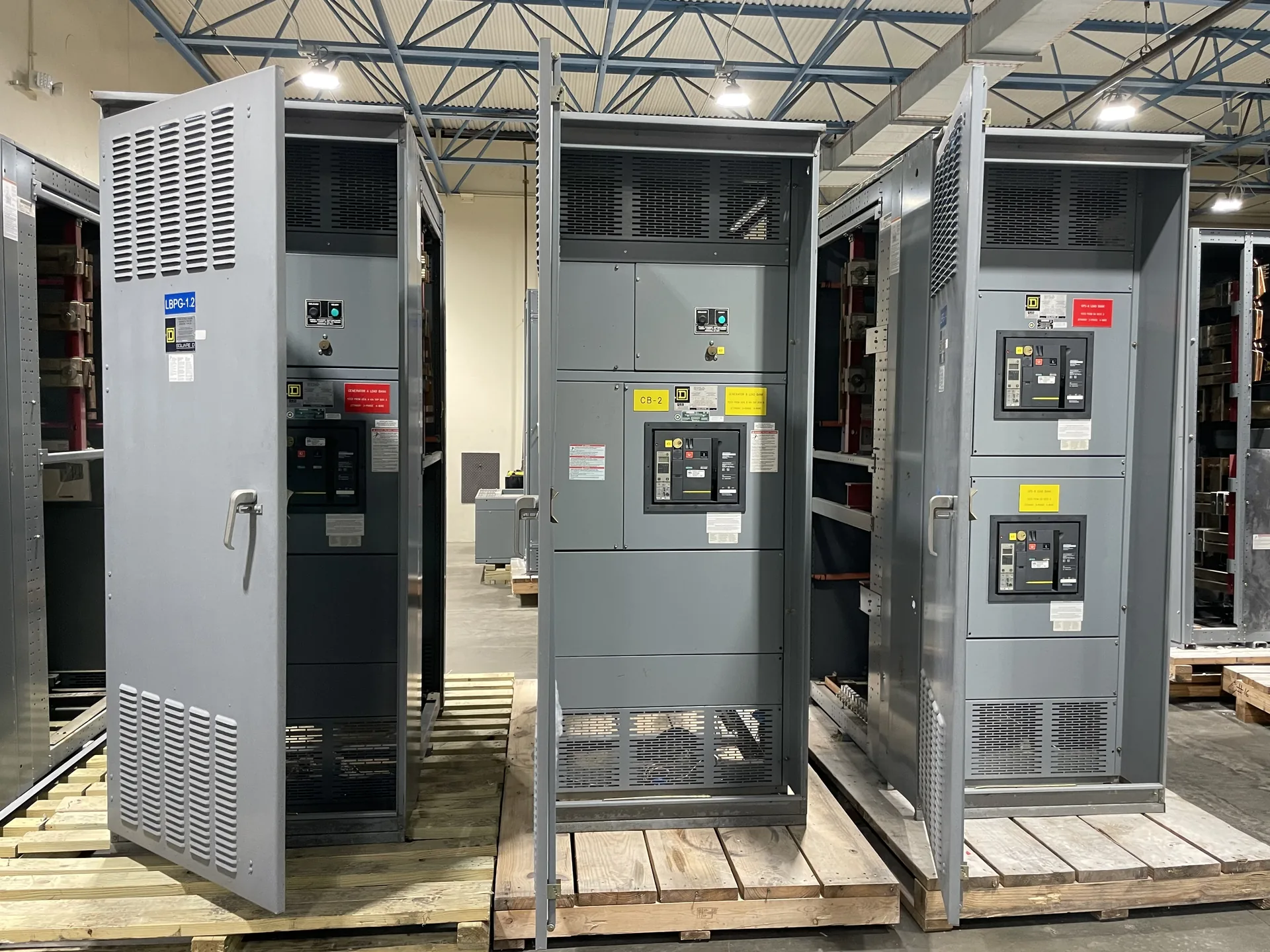
Power distribution, with purpose.
A sequence of operations (SOO) turns a critical-power design into explicit control behavior: which sources and breakers may operate, what conditions permit a transfer, and what the system does when a control input or communication link fails. It is not a substitute for a one-line diagram, protective-device coordination, or approved settings. For a new switchboard or switchgear package, the SOO should be developed from the actual source arrangement and load priorities, then reviewed with the engineer of record and other qualified project professionals before procurement and commissioning.
Define source states before writing transfer logic
Start by describing each source in observable terms. A utility source might be available only when its breaker is in the required position and the specified voltage and frequency conditions are acceptable. A generator source may additionally require a start permissive, run status, and a stable-output interval. If an uninterruptible power supply, tie breaker, or alternate feeder is part of the design, define its relevant states rather than treating it as an interchangeable source. Use the project’s nominal system voltage and the equipment’s applicable voltage rating accurately; they are related but not the same specification.
The design team needs the one-line diagram, source and breaker identifiers, normal lineup, load priorities, generator and UPS interfaces, and the required response to loss or restoration of each source. It also needs protective-device information and any limits on paralleling, closed-transition transfer, or load shedding. Those inputs reveal whether the control system should transfer, wait, shed selected loads, or remain in its existing state. Missing or contradictory source data is a design question to resolve, not a gap that should be filled with assumed operating behavior.
Make permissives and interlocks explicit
An SOO should distinguish a request from permission to act. A loss-of-source signal may initiate a transfer request, but breaker position, source availability, interlocks, and the approved transfer method determine whether a close command is permitted. State what blocks an operation, what condition clears the block, and whether a failed operation causes an alarm, a retry, or a stable lockout. Define the intended behavior for maintenance mode and manual control as well, including which automatic actions remain enabled.
Hardwired contacts and control wiring can provide direct status or permissive signals without depending on a supervisory network. Their exact role still needs definition: identify contact normal states, signal source, isolation requirements, and the equipment that receives each input. Mechanical or electrical interlocking may be appropriate where a prohibited breaker combination must be prevented, while control logic can manage timing and sequence. The selection depends on the design and hazard review; neither a generic logic statement nor a communication link should silently replace a required interlock.


Choose communication interfaces for a defined purpose
Communication interfaces can support remote monitoring, alarms, metering, event records, or supervisory commands, but the SOO should say which functions actually rely on them. Identify the intended protocol and interface only after confirming compatibility among the specified devices and control platform. Define the data points, command authority, time synchronization expectations, and who may change operating modes. A display that reports a breaker state is not automatically an approved control path for operating that breaker.
Specify behavior when a network, gateway, or supervisory controller becomes unavailable. Critical local protection and required transfer behavior may need to remain independent of remote communications, while alarms or remote visibility may be lost. The correct boundary is project-specific and must account for the selected equipment, cybersecurity requirements, and operating policy. Confirm interface capabilities with the manufacturers and integrator for the actual order; do not assume that a protocol name alone ensures compatible data, command handling, or failure behavior.
Work a hypothetical decision through the sequence
Consider a hypothetical facility with a normal utility source, a standby generator, and loads that must not be connected to both sources at once. The utility fails its defined availability criteria. The SOO could request generator start, wait for the approved generator-ready conditions, verify the required breaker positions and interlocks, and then permit an open-transition transfer. The specific thresholds, time delays, breaker commands, and load priorities are intentionally not supplied here: they must come from the project design and qualified engineering review.
If the generator does not become available, the sequence must say whether the system remains on the failed-source path, holds loads disconnected, or follows another engineered contingency. If the utility returns, the design must distinguish stable restoration from a momentary recovery and define whether retransfer is automatic or operator-controlled. The choice affects interruption risk, generator operation, load continuity, and the possibility of an unwanted operation during unstable conditions. A hypothetical sequence illustrates decisions to document; it is not a recommended setting or a universal critical-power design.
Specify failure behavior and records for review
For each important input and control path, record the expected response to an invalid, missing, stale, or contradictory signal. Consider a breaker that fails to reach its commanded position, a source indication that disagrees with measured conditions, a lost controller, or an unavailable communication channel. The SOO should identify alarms, inhibited actions, fallback states, and any operator decision required, while avoiding assumptions that a fault can be cleared by repeated automatic commands. Qualified professionals must establish safe work practices and the final protection, control, and operating settings.
The design record should include the one-line and control schematics, sequence narrative or state diagram, point-to-point and I/O lists, interlock matrix, alarm list, communication-point schedule, and approved settings documentation as applicable. Commissioning records should capture the tests performed and observed results under the approved plan, including relevant failure cases. Drawings and records need consistent device names and revision control so operators, engineers, and service personnel can distinguish intended behavior from a superseded draft.
Resolve options and quote inputs before procurement
Competing approaches can include hardwired transfer logic, programmable control, or a hybrid in which local hardwired permissives coexist with networked monitoring. The decision turns on the required independence, maintainability, desired transfer behavior, interfaces, and the consequences of a control failure. A simpler scheme may reduce integration dependencies but limit visibility or flexibility; a more connected scheme may improve monitoring while adding configuration and cybersecurity considerations. The engineer of record should resolve code interpretation and design acceptance with the relevant authorities and project stakeholders.
For a new custom-built distribution assembly, a purchaser should provide the one-line, voltage and current requirements, source and breaker information, fault-current and short-circuit requirements, enclosure and environmental details, control narrative, interface schedule, applicable standards, and delivery constraints. Identify any required U.S.-origin components or other sourcing conditions for confirmation, and state whether a UL 891 low-voltage switchboard assembly is specified where applicable; UL 891 is not a general medium-voltage equipment designation. A manufacturer can review the proposed scope and component availability for a specific order. Shorter lead time may be a goal, not a guarantee; ratings, standards, and final capabilities require project-specific confirmation. Dallas–Fort Worth purchasers should likewise coordinate shipping and receiving constraints without assuming a local manufacturing site.
Specifications & planning
Review the details that matter for your application. Final specifications and availability should be confirmed for your project.
| Evaluation factor | Decision to document |
|---|---|
| Source availability | Project-defined indications and acceptance conditions |
| Transfer method | Permitted breaker sequence and paralleling restrictions |
| Control dependency | Functions that remain available if communications fail |
| Failure response | Inhibit, alarm, fallback state, or operator action |
| Review basis | Approved drawings, settings, interfaces, and test records |