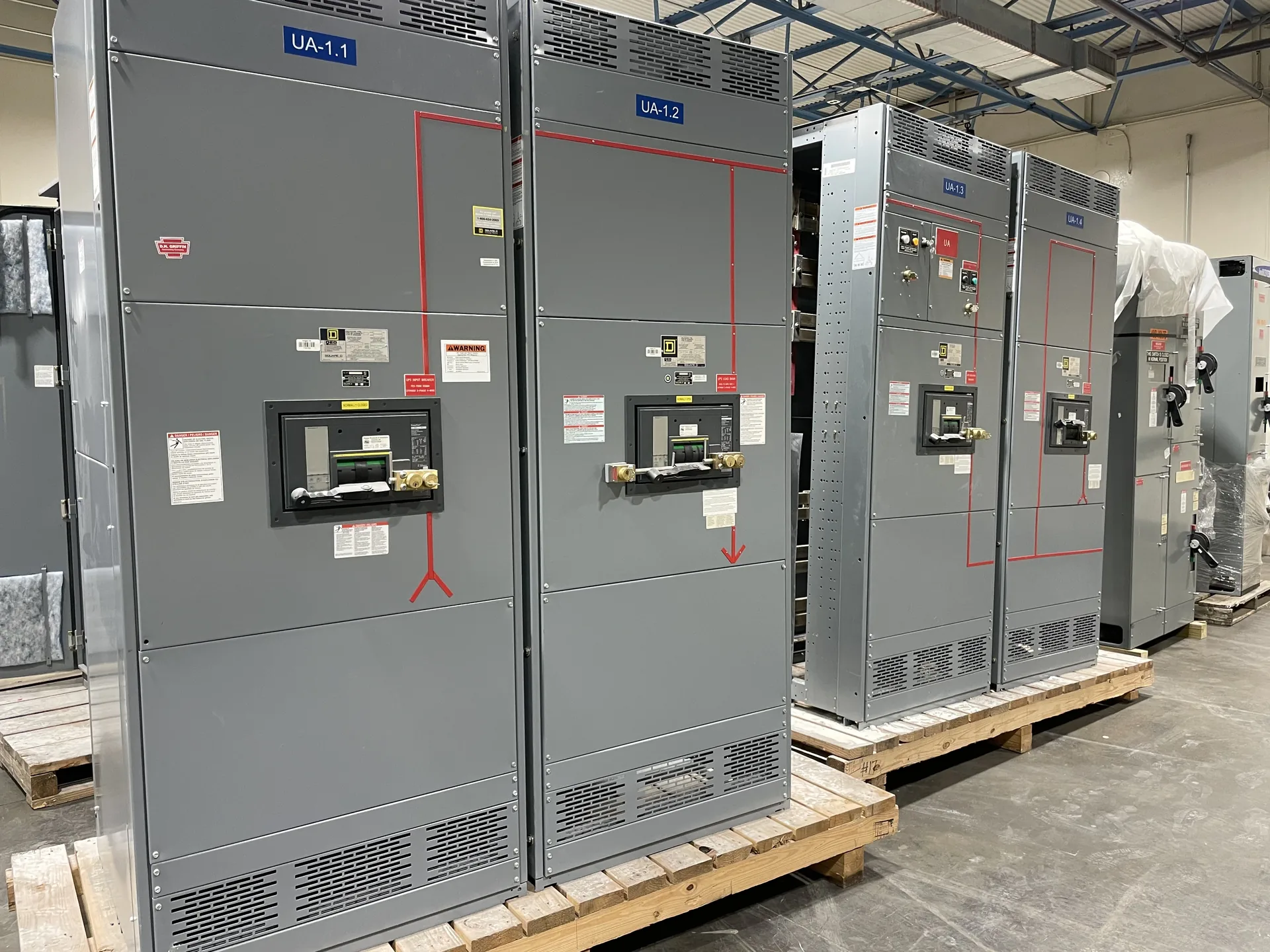
Power distribution, with purpose.
Dust protection and heat removal are linked design decisions: a tighter enclosure can reduce particle entry while making it harder to remove heat from bus, breakers and other components. The right balance depends on the actual contaminant, equipment losses, ambient conditions and maintenance plan—not on a generic “dusty location” label. This guide outlines the information needed to evaluate a specific low-voltage distribution assembly and the limits of that evaluation.
Characterize the exposure before choosing protection
Start with the dust itself and how it reaches the equipment. Record whether particles are coarse or fine, dry or damp, conductive or nonconductive, and whether they include fibers, metal, cement, grain, or process residue. Note nearby sources such as loading doors, unpaved approaches, cutting or handling operations, exhaust discharge, and housekeeping activity. A room described as clean may still experience brief clouds during material movement or filter changes.
Document both typical conditions and credible peaks: where the equipment will sit, whether doors remain open, how often the area is cleaned, and whether dust accumulates on horizontal surfaces. Dallas–Fort Worth sites can have different indoor and outdoor exposures depending on the building and process; regional location alone does not define the enclosure requirement. If conditions vary by season or operating mode, capture that variation rather than relying on a single observation.
Select an enclosure as part of the system
Specify the required enclosure construction and environmental protection for the actual exposure, access pattern and installation location. Consider seams, doors, cable-entry points, operating handles, ventilation openings and field modifications as potential paths for dust. A nominal enclosure designation is not a substitute for verifying what the selected construction protects against, how it is tested, and whether the complete assembled configuration maintains the intended protection.
More restrictive construction may limit particle entry but can complicate cooling, inspection and future changes. Filters or screened openings can reduce direct ingress, yet they can load with dust and obstruct airflow. Sealed or filtered approaches therefore need a defined service interval and access method. Confirm that cable routing, bottom plates, conduit interfaces and any site-installed accessories are compatible with the enclosure design; unreviewed penetrations can defeat the intended barrier.


Resolve heat removal with operating data
Thermal design should use the assembly’s expected losses and the conditions around it, not a room-temperature assumption alone. Supply anticipated continuous loading, load diversity, breaker and bus details, future capacity expectations, ambient temperature range, elevation if relevant, and nearby heat sources. Also identify whether cooling air is recirculated, filtered, conditioned or drawn from a dust-exposed space. Component availability and allowable operating limits must be confirmed for the specific build.
Compare natural convection, filtered ventilation and a more closed arrangement using the same duty assumptions. Ventilation may lower internal temperature when air is clean and the filter is maintained, but it creates an ingress path and a maintenance dependency. A tighter enclosure may reduce that path while increasing internal temperature or requiring another engineered heat-management method. The outcome may affect component selection, ratings and arrangement; no single enclosure choice establishes a usable rating without project-specific engineering.
Use inspection criteria that match the failure modes
Inspection planning should address where deposits are likely to form and what they could impair. Relevant observations can include filter loading, dust at door seals and cable entries, deposits on insulating surfaces, blocked ventilation passages, corrosion or moisture mixed with residue, and signs of abnormal heating. Define what is observable without opening energized compartments, who is qualified to inspect, and what conditions require escalation. Work practices and any electrical safety boundaries belong to the responsible qualified professionals.
A visual inspection schedule is useful only if it reflects the actual dust loading and access constraints. Establish a baseline after commissioning and adjust intervals from documented findings, filter condition and operating changes. Do not assume that a surface that looks clean proves internal cleanliness, or that compressed air or vacuuming is appropriate for a particular assembly. Cleaning methods, de-energization decisions and return-to-service checks require equipment-specific instructions and qualified judgment.
Worked hypothetical: compare two defensible approaches
Consider a hypothetical indoor distribution room beside a dry-material handling area. Fine dust is occasionally visible near the room entrance, while the equipment carries substantial continuous load and the room can become warm. Option A uses a comparatively closed enclosure with a heat-management approach evaluated against calculated losses. Option B uses filtered ventilation, with accessible filters, defined inspection responsibility and a replacement plan. Neither is automatically preferable: the first needs thermal evidence, and the second needs credible control of filter condition and dust exposure.
For this example, the decision turns on measured or otherwise supported peak ambient conditions, the nature and rate of dust deposition, available cooling methods, maintenance access and the consequences of filter neglect. If the room cannot support reliable filter service, the ventilated option may carry an unacceptable operational dependency. If the closed arrangement cannot keep component temperatures within applicable limits, its ingress advantage does not resolve the thermal problem. A qualified design review must settle the choice; this example is not a rating recommendation or a completed project.
Provide records and define the conclusion’s limits
For a useful quote and design review, provide the one-line diagram, system nominal voltage, available fault-current information, required continuous and short-circuit ratings, load schedule, future growth assumptions, room and equipment layout, cable-entry plan, ambient range, elevation where relevant, and a description of dust sources and maintenance access. Include applicable project specifications, preferred enclosure construction, ventilation or filtration constraints, and any required U.S.-origin provisions. Drawings should show equipment clearances, adjacent heat sources, door swing, air paths and interfaces with ducts, filters or building systems.
Retain the approved equipment drawings, component and enclosure documentation, thermal-design assumptions, protection and rating confirmations, installation records, and inspection or filter-service history. These records let later reviewers distinguish the original design basis from changed site conditions. A manufacturer can develop custom new equipment and work toward a shorter lead time, but availability, delivery timing, ratings, standards, and U.S.-origin requirements must be confirmed for the specific order. Any UL 891 applicability concerns low-voltage switchboards and must be confirmed for the particular assembly; it does not establish dust suitability or apply as a general medium-voltage listing. Final settings, work practices and code interpretation belong to qualified professionals.
Specifications & planning
Review the details that matter for your application. Final specifications and availability should be confirmed for your project.
| Evaluation factor | Information to establish |
|---|---|
| Dust exposure | Particle type, source, deposition pattern and peak conditions |
| Thermal basis | Load losses, ambient range, airflow path and nearby heat sources |
| Enclosure interface | Doors, seals, cable entries, vents, filters and field penetrations |
| Maintenance basis | Inspection access, filter service responsibility and recorded findings |