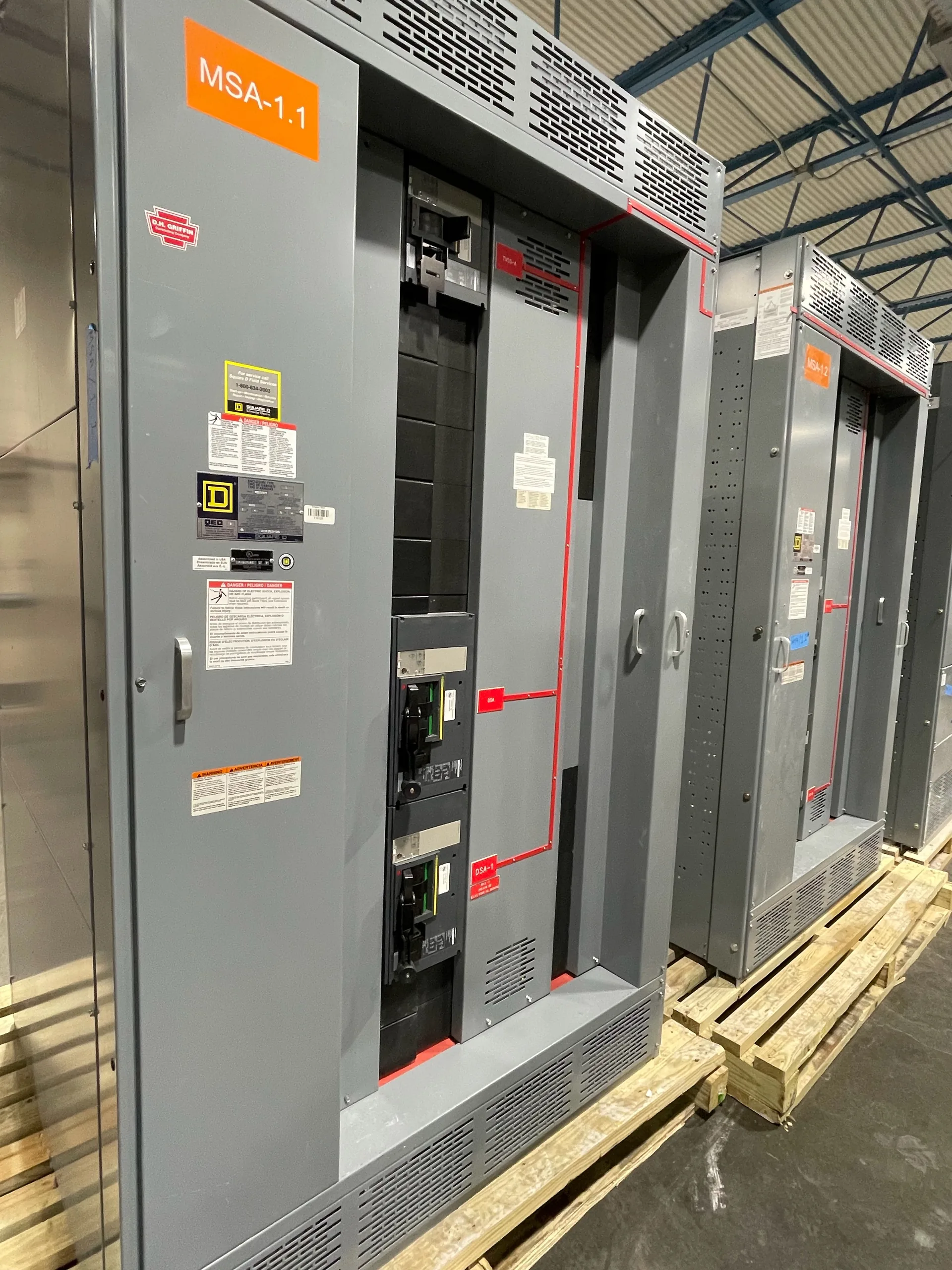
Power distribution, with purpose.
At an airport, rail facility, transit property, or other controlled transportation site, a switchgear delivery is a coordinated lift and access event—not simply a truck arriving at a dock. The route, permitted time window, unloading method, security process, and equipment dimensions should be reviewed together before a new assembly is specified and quoted.
Map the full delivery path before fixing dimensions
Start at the public-road approach and trace the equipment’s complete path to its final room or pad. Record gate clearances, turning radii, overhead obstructions, roadway weight limits, ramps, door dimensions, corridor widths, floor loading limits, and any transition between indoor and outdoor surfaces. A route that accommodates a tractor-trailer may still fail at a tight turn, a low canopy, or a doorway that cannot be opened fully. Confirm whether the switchboard or switchgear must travel as one assembly or in sections, and include packaging, skids, rigging points, and temporary protection in the dimensional review.
Transportation properties may have active passenger, aircraft, freight, or vehicle movements that constrain staging and require escorts. A site plan should identify where a delivery vehicle can wait without blocking operations, where unloading may occur, and how material moves from that point to the electrical room. For projects in Dallas–Fort Worth or elsewhere, local traffic conditions do not establish the site’s actual access rules; the owner’s route survey, permitted vehicle information, and current construction logistics plan are the controlling inputs.
Treat access windows as a design and logistics constraint
Ask the owner or construction manager to define the usable delivery window, including check-in time, security screening, escort availability, staging duration, noise restrictions, and the latest time unloading must be complete. A short overnight window may favor equipment that can be delivered in manageable sections, while sectioning can add field connections, alignment work, and coordination demands. Conversely, a larger factory-assembled lineup may reduce field assembly but require a wider route and a heavier, more complex lift. These are project tradeoffs, not assumptions that one delivery format is always preferable.
Build contingency into the plan for a missed gate slot, weather restriction, delayed escort, or conflict with a live transportation operation. Clarify who can authorize a changed delivery time and whether the carrier can hold the load elsewhere if access is unavailable. Delivery dates and shorter lead time may be goals in a procurement plan, but they are not guarantees; the manufacturer must confirm build scope, component availability, shipping arrangement, and schedule for the specific order.


Verify unloading, lifting, and temporary support
The unloading plan should identify the proposed equipment-handling method, lifting capacity and configuration, pick points, load distribution, travel path, and temporary bearing surfaces. Obtain manufacturer-approved handling information for the exact assembly and shipping configuration rather than deriving a lift from a general catalog image. Confirm whether the site permits a crane, forklift, gantry, or other means, and check ground-bearing capacity, overhead clearance, reach, outrigger placement, and separation from public or operational areas. Rigging and lift planning belong to qualified personnel under the applicable site rules.
A useful selection comparison weighs shipping size and mass against access limits, assembly complexity, and the consequences of a delivery interruption. Smaller sections can ease a constrained route or lift but may require more field joining and verification. A consolidated assembly can simplify some site work while increasing transport and unloading demands. Equipment ratings, section dimensions, shipping weights, lifting details, and available components must be confirmed for the proposed design; do not treat an illustrative example or preliminary layout as approved for construction.
Coordinate owner security and operational controls
Controlled sites may require advance worker and vehicle rosters, identity checks, approved carrier information, escort arrangements, restricted-device rules, photography limits, and declarations of tools or materials. Determine what information must be submitted, by whom, and how far ahead of the requested window. Security requirements can affect packaging labels, delivery paperwork, driver instructions, and whether a vehicle may remain on site after unloading. Share only information the owner authorizes and use the site’s designated process for handling sensitive plans.
The owner’s security office, facilities or operations representative, general contractor, electrical engineer, carrier, rigging lead, and switchgear manufacturer have different approval roles. The owner defines access and security permissions; the engineer and owner establish electrical design requirements; the contractor coordinates site readiness; and the carrier and qualified lifting team confirm transport and handling arrangements. A manufacturer can provide order-specific equipment information for review, but should not be represented as granting site access, approving a lift, or authorizing work in an operating transportation area.
Illustrative scenario and quote-ready inputs
Consider a hypothetical transit facility with a narrow service entrance, a fixed overnight delivery slot, and a switchgear room reached by a corridor that cannot accommodate the full lineup. The project team might compare a sectional configuration against a single shipment, then evaluate whether each section can be safely unloaded and moved within the approved route and window. The sectional option could ease movement but introduce field-connection and sequencing considerations. Neither option is automatically suitable: the owner’s route dimensions, structural limits, electrical design, and qualified lift review must establish feasibility.
For a useful quote request, provide the one-line diagram, system nominal voltage, requested equipment type and configuration, bus and protective-device requirements, interrupting or short-circuit criteria, applicable project specifications, and the desired delivery schedule. Include equipment-room and route dimensions, access-window rules, unloading location, lifting or floor-load limits, security-submittal requirements, and any restrictions on shipment size or packaging. State which details are preliminary and identify the engineer, owner, and contractor contacts responsible for technical and logistics decisions. The manufacturer can then assess a new custom build and confirm applicable ratings, component availability, standards, origin requirements, and schedule for that order.
Keep approvals distinct from procurement decisions
Delivery feasibility is not the same as electrical design approval or site authorization. Before release, the responsible parties should reconcile the approved submittal dimensions and shipping configuration with the latest route survey and lift plan. Changes to doors, temporary construction, room access, or site operating hours can invalidate an earlier logistics review. Record who accepts each drawing, handling document, access request, and delivery date so a procurement assumption is not mistaken for owner approval.
For low-voltage switchboards, UL 891 may apply where appropriate, but it does not constitute a general listing for medium-voltage or high-voltage switchgear. Confirm the applicable standard and any required certifications or documentation for the particular assembly rather than assuming them from a voltage label or product category. System nominal voltage and equipment maximum rating are distinct; ratings, short-circuit capability, standards, U.S.-origin requirements, and component availability all require order-specific confirmation.
Specifications & planning
Review the details that matter for your application. Final specifications and availability should be confirmed for your project.
| Evaluation factor | What to confirm |
|---|---|
| Route envelope | Measured clearances, turns, overhead obstacles, and final room entry |
| Delivery window | Allowed arrival, check-in, unloading duration, and contingency authority |
| Lift and support | Order-specific handling data, qualified lift review, and surface capacity |
| Security process | Roster deadlines, escort rules, vehicle screening, and material controls |