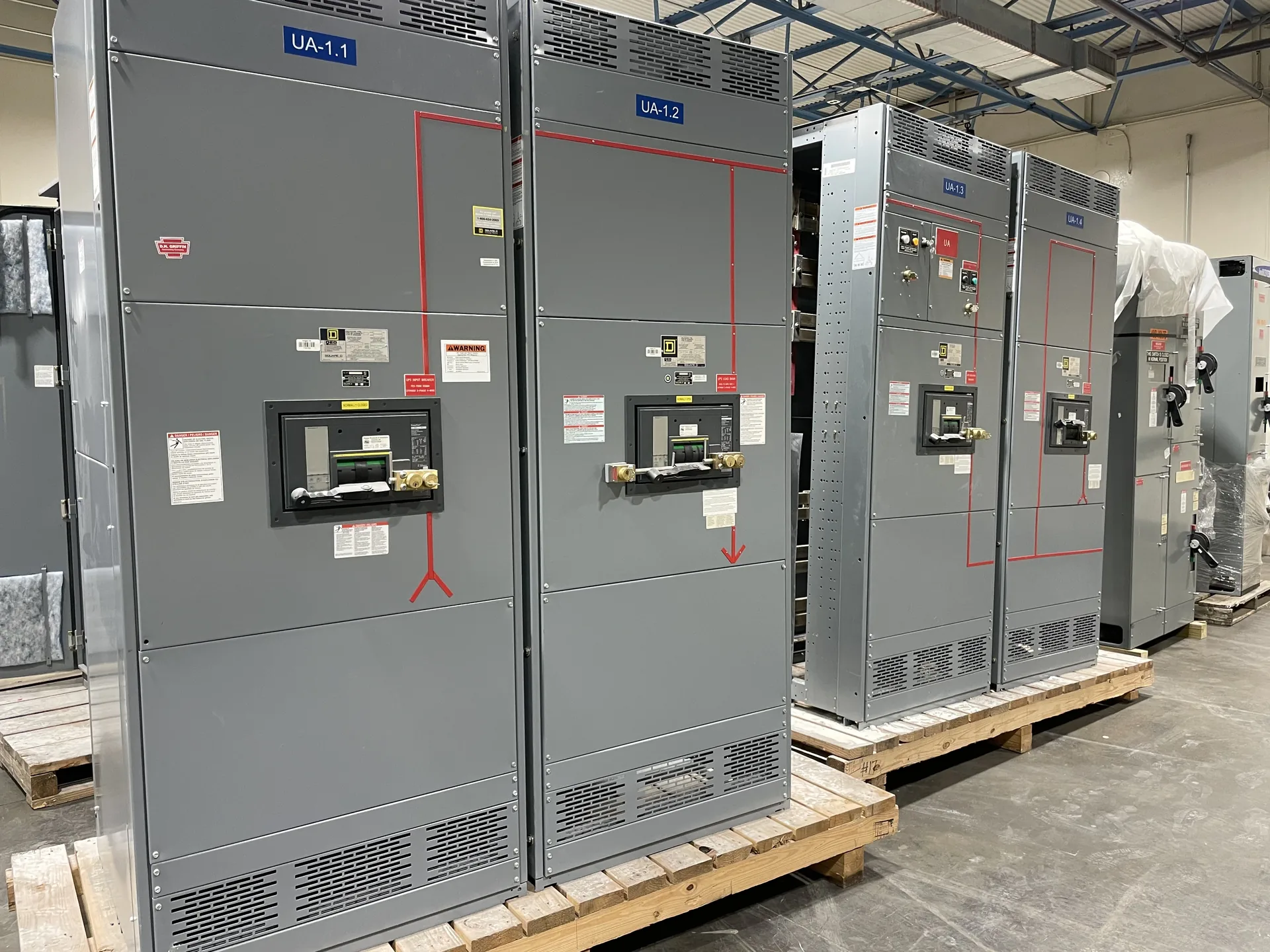
Power distribution, with purpose.
A switchgear design review turns a purchase specification and project requirements into a coordinated, reviewable equipment design. Clear milestones help owners, engineers, contractors, and the manufacturer identify open decisions before they affect drawings, interfaces, or fabrication. For new equipment, acceptance should be documented against an agreed scope; it is not a substitute for confirming ratings, codes, or responsibilities for the particular project.
Start with a complete design basis
The review begins with the information needed to define what the assembly must do and where it must connect. A purchaser requesting a quote should provide the one-line diagram, project specification, nominal system voltage, frequency, available fault-current information, service and load requirements, and the intended installation environment. Include preferred manufacturers or approved component constraints, control and metering functions, and any required standards or U.S.-origin provisions. Missing or conflicting inputs can make both the proposal and later drawing review less reliable.
The design basis also needs physical and commercial boundaries. Share room plans, equipment access and egress constraints, cable entry and termination requirements, conduit or bus interfaces, environmental conditions, delivery constraints, and the project schedule. Identify who supplies connected transformers, protective devices, control wiring beyond the assembly, and field terminations. These details help distinguish manufacturer scope from work by others. For Dallas–Fort Worth projects or shipments elsewhere in the United States, delivery planning should be based on the actual destination, unloading arrangement, and site restrictions, not an assumed local installation capability.
Review the submittal as a coordinated package
A useful submittal should give reviewers enough information to check the proposed configuration against the design basis. Depending on the agreed scope, the package may include general arrangement drawings, elevations, compartment or section layouts, one-line and schematic diagrams, wiring information, bills of material, device data, and nameplate or marking details. The exact deliverables must be confirmed for the order; a drawing set should not be presumed to include every study, calculation, or field document a project may require.
Reviewers should check that equipment descriptions, section lineups, circuit designations, component selections, and connection points agree across the documents. Compare the proposed dimensions and access clearances with the room layout, and verify that cable and bus interfaces match the adjoining equipment. Check whether specified nominal voltage, equipment maximum rating, continuous current, and short-circuit duty are stated distinctly and consistently. A low-voltage switchboard designed to UL 891 is different in scope from medium-voltage equipment; 5 kV, 15 kV, 27 kV, and 35 kV are normally medium-voltage classes here and are not UL 891 ratings. Applicable standards and construction details require project-specific confirmation.


Resolve comments with ownership and evidence
Comments are most useful when they identify a drawing reference, the requirement at issue, and the requested correction or clarification. Separate mandatory changes from questions, preferences, and notes for coordination. The manufacturer can evaluate comments affecting its supplied design, while the purchaser and project engineer should identify who has authority to interpret the project specification, approve deviations, and coordinate requirements from other trades. Do not assume that a reviewer’s silence, a meeting discussion, or a mark-up alone constitutes acceptance.
For each comment, record its disposition: accepted, revised, clarified, or not accepted, with an explanation where needed. If a requested change affects price, schedule, ratings, interfaces, or scope, resolve that consequence through the project’s change process rather than treating it as a drafting correction. Maintain a comment log linked to drawing revisions so reviewers can verify that changes were incorporated and avoid reopening closed decisions. This record is particularly valuable when one-line diagrams, room layouts, and equipment drawings are being updated by different parties.
Document acceptance without overstating it
Design acceptance should identify the specific document revisions reviewed, the approving party, the date, and any exceptions that remain open. The project should define whether approval means accepted for coordination, accepted with comments, or accepted for manufacture, and what conditions must be closed before the next gate. Approval of a drawing does not by itself establish that every project code obligation, field condition, or connected-system interface has been satisfied. The contract and project procedures determine who may approve and what that approval means.
A purchaser should retain the accepted submittal, comment log, applicable specification revisions, and approved deviation records together. If a later change alters loads, protective-device requirements, cable entry, room dimensions, or the specified components, identify which documents and decisions must be revisited. This protects the design record from relying on superseded assumptions and gives the manufacturer a clear basis for evaluating the requested revision. Acceptance authority and review turnaround are project-specific; neither should be inferred from a generic milestone description.
Set a controlled release-for-manufacture gate
Release for manufacture is a distinct authorization, not merely the return of reviewed drawings. Before release, confirm that required comments are closed or explicitly carried as approved exceptions, the equipment configuration and interfaces are stable, and commercial and technical changes have been reconciled. Confirm the controlling drawing revision, required deliverables, component selections, and any unresolved dependencies on purchaser-furnished information. A release record should show who authorized the gate and precisely which revision and scope may proceed.
If a design is still subject to changes, a planned review and release process can make those dependencies visible without promising a particular turnaround or fabrication date. The purchaser and manufacturer should agree how late changes will be assessed, documented, and authorized, including possible effects on schedule or cost. Custom builds using American components may be considered where compatible with the specification and available for the order; component availability, U.S.-origin requirements, ratings, standards, and any UL 891 applicability must be verified for the specific design. Shorter lead time can be a goal, not a guarantee, and should be evaluated only against the confirmed scope and supply conditions.
Specifications & planning
Review the details that matter for your application. Final specifications and availability should be confirmed for your project.
| Review factor | What to verify |
|---|---|
| Design basis | Inputs, assumptions, and conflicts are identified |
| Interfaces | Dimensions, access, cable entry, and adjoining connections coordinate |
| Comment status | Disposition is traceable to the affected document revision |
| Release authority | Approver, accepted scope, exceptions, and controlling revision are recorded |