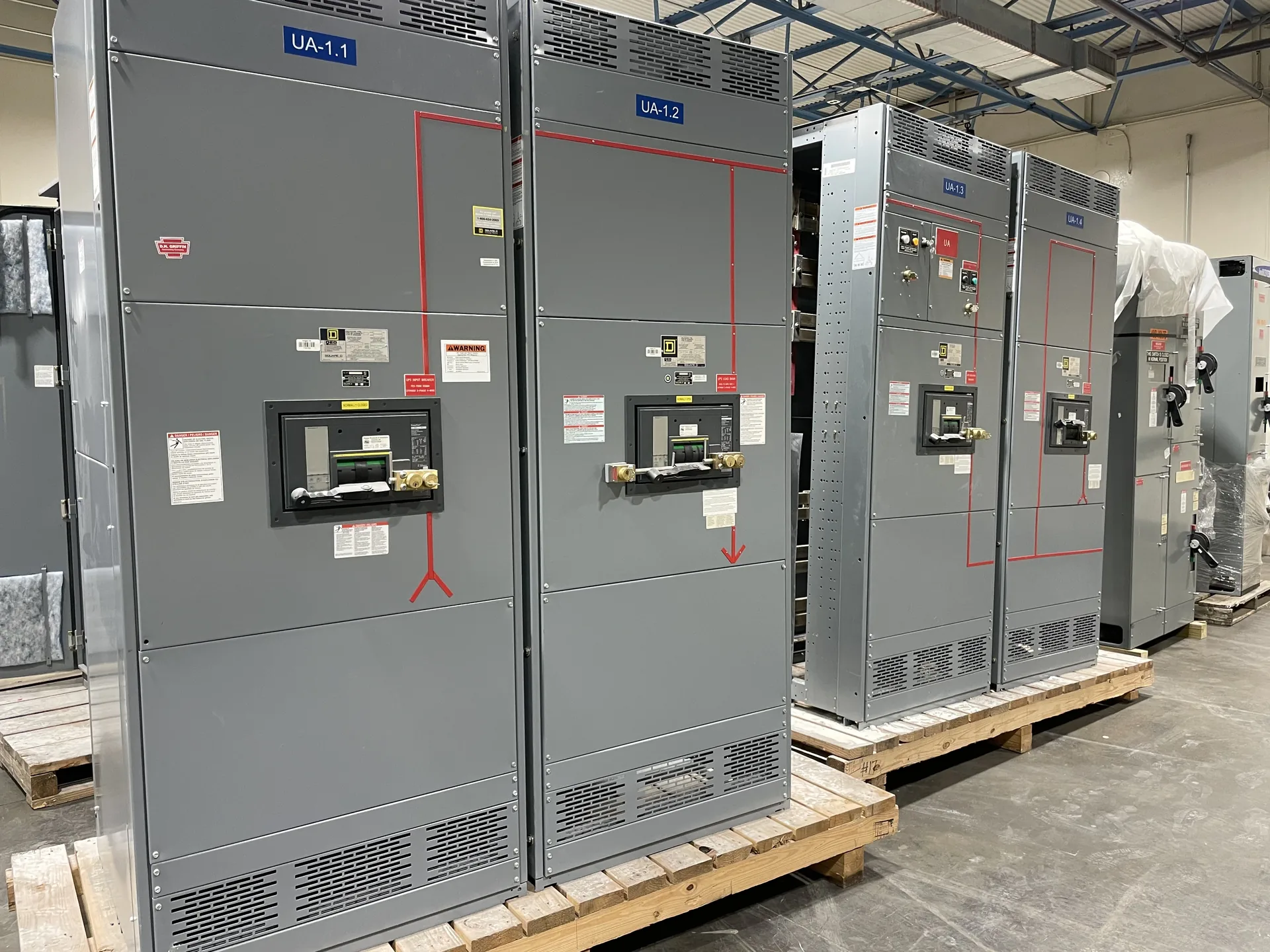
Power distribution, with purpose.
Switchgear procurement for a new building is a sequence of decisions, not a single purchase order. Align the design basis, quotation scope, approval path and delivery handoff early so equipment can be evaluated against the project’s actual electrical requirements.
Set a usable preliminary design basis
Before requesting a quotation, establish what the switchgear must do in the system. Provide the one-line diagram, system nominal voltage, service configuration, frequency, phase and wire requirements, and the intended role of each lineup. Identify the available fault-current information and the required short-circuit rating at the equipment location; do not treat nominal system voltage as the equipment’s maximum rating. These inputs let the manufacturer assess a defined application rather than guess at the design.
Record project constraints that affect the physical and electrical arrangement: indoor or outdoor use, environmental conditions, room dimensions, access and maintenance clearances, cable entry and exit directions, conduit or busway interfaces, and any future provisions. Mark information that is preliminary, such as transformer data or final utility fault calculations. A quotation can identify assumptions, but unresolved design inputs should remain visible so they can be closed before approval rather than silently becoming procurement requirements.
Issue a quotation request with clear boundaries
A useful request identifies the equipment type and scope, requested quantity, project schedule milestones, delivery destination and the documents needed for evaluation. Include the applicable specification and drawing revisions, preferred manufacturers or named components where required, metering and protection requirements, control-power needs, communications protocols, labeling conventions, and any project-specific testing or documentation clauses. State which items are mandatory and where an approved alternative may be considered. For a low-voltage switchboard, UL 891 may be relevant; it is not a general listing for medium-voltage switchgear.
Define interfaces rather than assuming they are included. Clarify whether the quotation covers the switchgear assembly only or also protective devices, metering, control wiring, transition sections, external cables, field connections, installation, commissioning, or engineering services. A manufacturer builds and supplies new equipment; purchasers should not presume installation or other field services unless those capabilities and responsibilities are confirmed. Buyers in Dallas–Fort Worth and elsewhere should provide the actual ship-to location and site receiving constraints, not infer a local factory or installation service from regional coverage.


Compare quotations on scope, not headline price
Review each proposal against the same design basis. Check lineup arrangement, bus and device requirements, stated voltage and short-circuit ratings, enclosure and environmental assumptions, included accessories, exclusions, drawing deliverables, and the proposed delivery basis. Confirm that any cited standard or UL 891 assembly applicability matches the equipment type and the specific offered configuration. Ratings, component availability, standards applicability, and U.S.-origin requirements must be confirmed for the particular order; a general statement should not replace written project-specific confirmation.
Treat schedule as a planning input with dependencies, not an implied guarantee. Ask what information, approvals, components, and customer decisions the proposed schedule assumes, and identify how changes may affect it. Custom builds using American components and shorter lead time as a goal may be relevant to procurement planning, but neither establishes universal component availability nor guarantees a delivery date. Record technical deviations and commercial exclusions in a comparison so a low initial figure does not conceal a different scope.
Use submittals to resolve design interfaces
After award, review the manufacturer’s submittals against the released project documents, not merely against the earlier quotation. Check the general arrangement, elevations, dimensions, access clearances, cable landing space, busway or transformer connections, device schedules, control schematics, metering, nameplates and terminal designations. Confirm that the submittal reflects the intended system voltage and available fault-current basis, and route any unresolved engineering assumptions to the responsible design professional. Approval should not be used to transfer the designer’s responsibility for system coordination or code decisions to the equipment supplier.
Make comments specific and dispositionable: identify the drawing, location, requirement and requested correction or confirmation. Track revisions so the approved set is unmistakably current, and distinguish approval to proceed from approval of an exception. If a requested change affects ratings, layout, components, scope or schedule, obtain a written impact review before accepting it. This disciplined review is especially useful when electrical, architectural, structural and controls stakeholders are working from different drawing releases.
Prepare receiving as a procurement milestone
Before shipment, assign a receiving owner and verify the site can accept the planned delivery. Confirm the delivery address, access route, unloading equipment and responsibility, receiving hours, storage conditions, packaging disposition, and any carrier or site appointment requirements. Compare the expected shipment configuration with the approved lineup and identify whether sections will arrive assembled or divided for transport. Resolve temporary storage and protection needs with the project team; a delivery date alone does not establish that the room, access path or unloading plan is ready.
At receipt, use the shipping documents and approved equipment identification to reconcile what arrived with the purchase scope. Inspect packaging and visible condition, record discrepancies or damage promptly under the applicable carrier and contract procedures, and preserve relevant documentation. Do not treat receipt as authorization to energize or as a substitute for installation, inspection, testing or commissioning requirements. Route technical questions and any apparent mismatch through qualified project personnel and the manufacturer before the equipment is incorporated into the system.
Worked example: make the handoff explicit
Consider a hypothetical commercial building whose preliminary one-line shows a low-voltage service switchboard, while the final transformer fault-current calculation is still pending. The purchaser can issue the quotation request with the current diagram, clearly label the fault-current value as unconfirmed, and request written confirmation of the assumptions used in the proposal. The team can compare scope and arrangement now while making the final rating confirmation a hold point before approval for manufacture. This avoids pretending that an early estimate is a verified equipment requirement.
The actionable handoff is a controlled package: the purchaser supplies the current specification and drawings, a requirements-and-deviations record, known interface dimensions, schedule assumptions, delivery constraints and named approval responsibilities. The manufacturer returns a scoped quotation and, after award, submittals for review; the purchaser’s design team closes open electrical inputs and issues documented comments or approval. Before release and again before delivery, the parties confirm the current configuration, unresolved exceptions and receiving readiness. That record makes the next decision clear without inventing durations or assuming unverified capabilities.
Specifications & planning
Review the details that matter for your application. Final specifications and availability should be confirmed for your project.
| Evaluation factor | Evidence to request or confirm |
|---|---|
| Design basis | Current one-line, system nominal voltage, fault-current basis and revision status |
| Scope boundary | Written inclusions, exclusions, interfaces and responsibility assignments |
| Submittal control | Revision-matched drawings, comment dispositions and approval status |
| Receiving readiness | Ship-to constraints, unloading responsibility, inspection and discrepancy process |