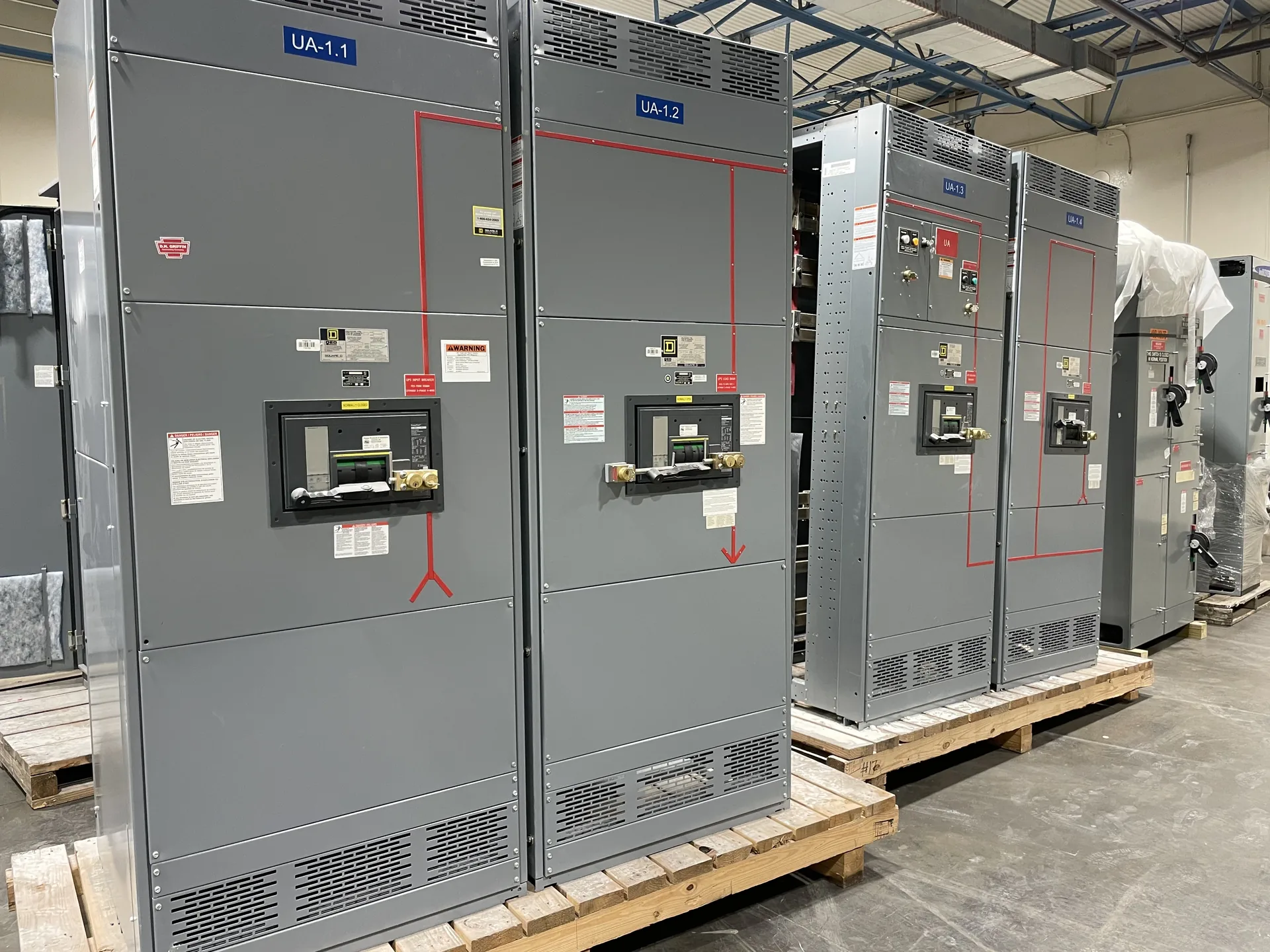
Power distribution, with purpose.
A useful new switchgear quote starts with a defined electrical duty and a clear boundary for what the equipment must include. When requesting a quote, provide the available system information, operating requirements, drawings, and project schedule—not just a voltage or equipment name. Those details let a manufacturer identify assumptions, flag unresolved interfaces, and develop a proposal that can be compared fairly with alternatives. The company builds and supplies new equipment, with custom configurations and American components available where specified; requirements and availability must be confirmed for each order.
Define the electrical duty before comparing prices
State the system’s nominal voltage, frequency, phase, wire arrangement, and grounding method, and identify whether the request is for low-voltage switchboards or medium-voltage switchgear. Include the service conditions that affect selection, such as the available fault current or required short-circuit rating, the upstream protective device, and any known source or transformer information. Nominal system voltage is not the same as an equipment’s maximum rating, so both the system context and the required equipment rating need engineering review.
If fault-current data is not yet available, say so rather than substituting a guessed value. A quote based on an assumed rating may be unsuitable once the utility, transformer, or upstream protection is confirmed. For low-voltage switchboards, UL 891 may be relevant to the requested assembly, but it does not apply as a general listing for medium-voltage equipment. State applicable project standards and documentation expectations, while recognizing that ratings, standards, and assembly status must be confirmed for the specific order.
Describe the lineup and its electrical interfaces
Send a one-line diagram when available and identify the intended lineup arrangement, number and function of sections, incoming sources, bus ties, feeders, and metering points. For each circuit, provide the known continuous load, protective-device type and size, control requirements, and any requested spare or future provisions. A circuit schedule can resolve ambiguities that a broad description such as “main-tie-main” or “distribution switchgear” leaves open.
Connection details matter just as much as the section count. Identify cable or busway entry direction, termination preferences, conductor material and size if established, neutral and ground requirements, and the location of connections relative to the lineup. Note how the equipment must interface with transformers, generators, transfer equipment, downstream panels, or building controls. Existing drawings may be preliminary; label them with revision and status so the quote does not treat a concept layout as an approved construction document.


Set physical, environmental, and access constraints
Provide the available equipment-room dimensions, ceiling or overhead obstructions, door openings, floor or housekeeping-pad conditions, and required working clearances as known. Explain whether the lineup must fit an existing footprint or can be arranged around electrical needs. A compact arrangement may reduce room demand but can constrain access, cable bending space, or future expansion, so the tradeoff should be visible before a configuration is selected.
Describe the installation environment rather than assuming ordinary indoor conditions. Relevant information can include indoor or outdoor placement, ambient temperature, altitude, moisture, dust, corrosive exposure, seismic criteria, and enclosure expectations. For a project in Dallas–Fort Worth, delivery planning may also depend on the receiving site’s access, unloading capability, and construction sequence; serving the region does not imply a local factory or installation service. The purchaser should identify the delivery destination and site restrictions without assuming a delivery method or date until confirmed.
Make the scope boundary explicit
Clarify whether the request covers the complete switchboard or switchgear assembly, specified protective and control components, metering, internal wiring, labeling, drawings, and other documentation. Identify owner-furnished or separately purchased devices and state who is responsible for compatibility information and final interface data. If control schematics, communications, or remote monitoring are required, describe the protocols and signals that must connect to the project’s systems.
A quote is easier to evaluate when exclusions and assumptions are written plainly. Ask the supplier to identify unresolved data, assumed component selections, and items that may change after drawing approval. Custom builds can align equipment with a project’s one-line and interfaces, while component availability and American-origin requirements need confirmation for the actual bill of materials. If domestic-content rules apply, name the governing project requirement rather than using a general request for “American made” as a substitute for defined criteria.
Provide schedule information without treating it as a promise
Share the required on-site date, the date the electrical design is expected to be released, and any approval milestones that affect procurement or production. Identify whether the project is phased, whether equipment must arrive in a particular sequence, and when final loads, cable details, or control interfaces will be available. These milestones help a manufacturer assess the requested schedule and identify information that could delay a firm configuration.
Shorter lead time may be a project goal, but it is not a guaranteed outcome. Customization, component supply, design changes, drawing review, and order-specific ratings all influence timing. Ask for the schedule basis and the events that start it, then confirm any delivery commitment in the order documents. A quote that explains its assumptions is more useful than an attractive date unsupported by defined scope.
Compare proposals on the same technical basis
When comparing new-equipment quotes, align the one-line revision, circuit schedule, required ratings, physical arrangement, scope inclusions, and delivery destination. Check whether each proposal addresses the same accessories, metering, controls, documentation, and future provisions. A lower initial figure may reflect a different equipment boundary, an assumed rating, or excluded components rather than a directly comparable design.
Request a clear list of exceptions and open questions before purchase. Confirm that the proposed equipment is suitable for the project’s system and that all ratings, short-circuit requirements, standards, component availability, and origin conditions are resolved for the specific order. The table below provides an example of quote-review factors, not offered equipment ratings or a substitute for engineering review.
Specifications & planning
Review the details that matter for your application. Final specifications and availability should be confirmed for your project.
| Evaluation factor | What to provide or confirm |
|---|---|
| System duty | Nominal voltage, frequency, grounding, and available fault-current basis |
| Lineup and circuits | One-line revision, section functions, feeder schedule, and future provisions |
| Interfaces | Cable entry, terminations, controls, metering, and connected equipment |
| Site constraints | Room dimensions, environment, access, and delivery destination |
| Scope and schedule | Inclusions, exclusions, approval milestones, and schedule assumptions |