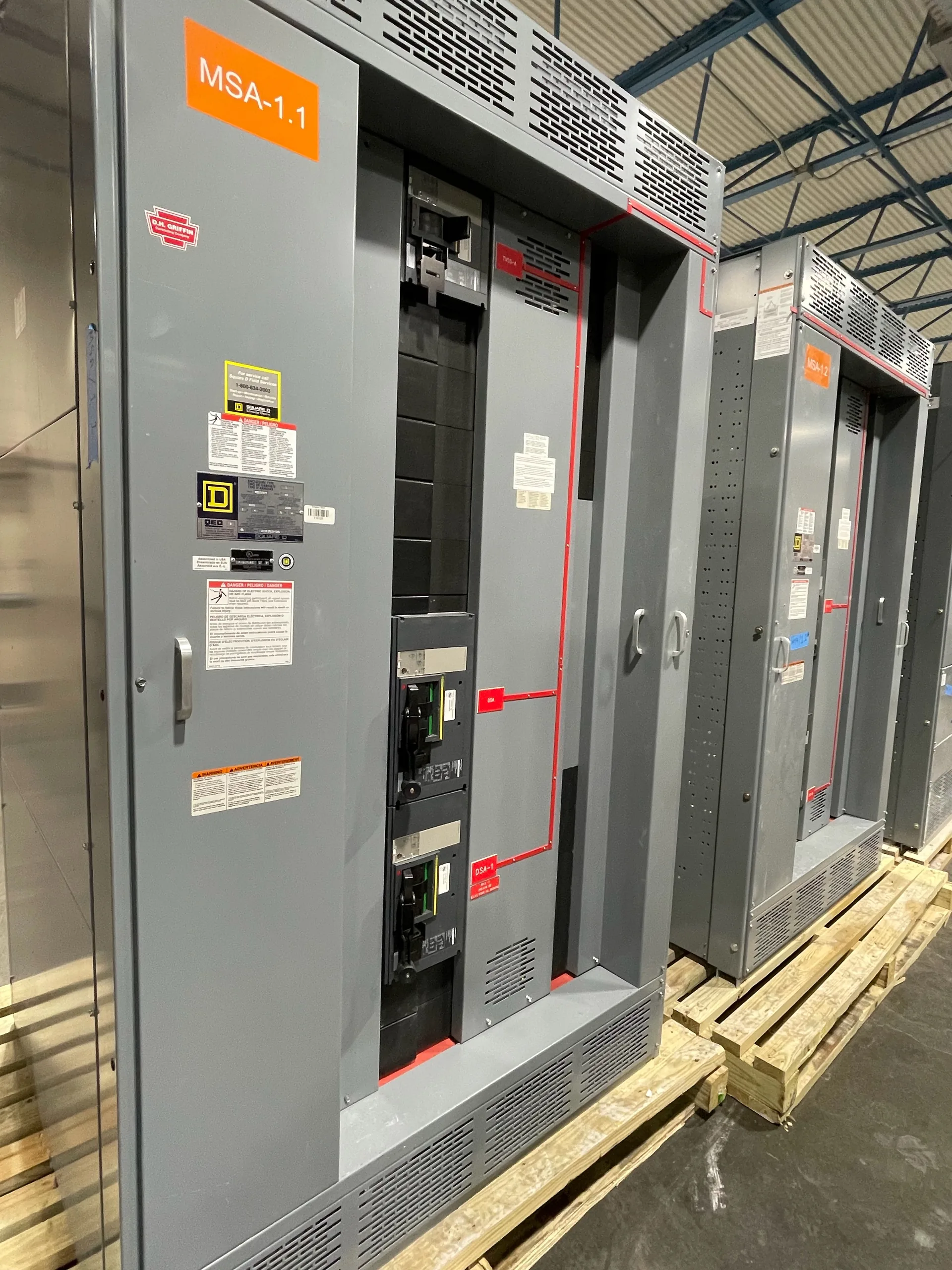
Power distribution, with purpose.
A switchgear short-circuit rating describes how much fault-current stress an assembly can withstand under specified conditions; it is not simply the current a breaker can interrupt. Choosing an appropriate rating starts with the available fault current at the equipment location and continues through the assembly, protective devices, and system configuration. These distinctions matter when specifying new switchgear for a facility in Dallas–Fort Worth or elsewhere, because a rating mismatch can leave equipment inadequately protected or unnecessarily costly.
Three ratings answer three different questions
Available fault current is the current a power system could deliver at a particular point during a short circuit. It depends on the utility source, transformers, conductors, generators, motors, and the system arrangement. A short-circuit study estimates that current for defined operating conditions. The result is a system value at a location, not a rating assigned to the switchgear itself, and it can change after a transformer, feeder, or source configuration changes.
An assembly withstand rating indicates the fault-current stress the switchgear can endure for a stated duration or within a defined protective arrangement. A breaker’s interrupting rating, by contrast, addresses its ability to interrupt fault current at its terminals under specified conditions. These values are related, but not interchangeable: the breaker must be suitable for the available current, and the assembly’s ratings and tested configuration must also be appropriate. The equipment specification must preserve those distinctions rather than use one number as shorthand for all three.
How to read a rating in its system context
Short-circuit ratings are expressed with conditions that affect their meaning, including voltage, current, duration, and sometimes the protective device or specific assembly configuration. A rating at one voltage should not automatically be carried over to another. Nor should a purchaser assume a switchboard’s withstand figure alone establishes that every installed breaker has adequate interrupting capability. Review the equipment documentation and coordination study together, with attention to the exact lineup and protective devices being specified.
Distinguish system nominal voltage from the equipment’s maximum voltage rating. For example, a system described by its nominal voltage does not make that value identical to an equipment maximum rating or short-circuit rating. The applicable values depend on the design and governing requirements for the order. Ratings, component availability, applicable standards, and any U.S.-origin requirements should be confirmed for the specific build rather than inferred from a general product description.


A practical example of the comparison
Consider a hypothetical facility whose engineering study reports 42 kA of available fault current at a proposed switchgear connection for a defined operating condition. That result is not a request to choose equipment marked with the nearest convenient number. The engineer must verify the study basis, voltage, applicable duty and time conditions, and whether the reported value accounts for all sources that may operate together. The assembly and each relevant interrupting device must then be evaluated against the applicable design requirements.
If the available current exceeds a device’s interrupting capability, the design cannot rely on the assembly withstand number to make that device adequate. If assembly capability is insufficient for the duty or protective arrangement, a breaker with a higher interrupting rating does not by itself resolve the assembly issue. Possible design responses may include changing the system configuration, selecting different equipment or protective devices, or revising the source arrangement. A qualified engineer must assess the options, including coordination, operating needs, and applicable codes.
Design choices that can change the result
The fault-current estimate is tied to system conditions, so source changes deserve attention. Parallel transformers, a closed bus tie, onsite generation, or large motors can affect the current available at a point. A study based only on normal operation may not represent a credible alternate configuration. Conversely, assuming every source is always connected may lead to a design that does not match the actual operating scheme. The engineer should define the cases to be evaluated and identify interlocks or operating restrictions the design depends on.
Protective-device selection and coordination also involve tradeoffs. A device’s interrupting capability is only one selection criterion; its trip settings, coordination with upstream and downstream protection, and relationship to the assembly matter as well. Current-limiting devices or other engineered measures may affect downstream exposure, but their suitability must be established for the specific equipment and system. Do not assume a protective device raises an assembly rating or that a field change preserves a tested configuration without written engineering review.
Information to provide when requesting new equipment
For a useful quotation, supply the one-line diagram, nominal system voltage and frequency, source and transformer data, and the available fault-current study or its assumptions. Identify the point where the equipment connects, normal and alternate source configurations, bus-tie operation, and any onsite generation or large motor contributions. Include the required assembly withstand and device interrupting criteria if the engineer has established them, along with metering, protective-device, enclosure, and lineup requirements that affect the build.
A manufacturer can use this information to develop a proposed new assembly and identify questions that need engineering resolution; it should not substitute an assumed fault-current value for a project study. Custom builds, American components, and shorter lead time as a goal can be discussed for the order, but component availability, ratings, standards, and U.S.-origin requirements need confirmation. UL 891 may apply to low-voltage switchboards where appropriate; it is not a general listing for medium-voltage equipment, and no particular assembly’s status should be presumed.
When to involve a qualified professional
Engage a qualified electrical engineer or other appropriately qualified professional when the available fault current is unknown, the study is outdated, operating configurations are changing, or equipment and device ratings do not clearly align. Professional review is also important when replacing existing gear, adding a transformer or generator, changing protective settings, or evaluating a proposed current-limiting approach. A purchase decision should follow a documented technical basis, not a visual comparison of nameplate numbers alone.
After installation, changes to the electrical system can alter fault-current levels and protection behavior, so preserve the study assumptions and equipment documentation for future review. Work involving energized equipment presents serious hazards and belongs with qualified personnel using applicable safety procedures; this page is not a field-testing or adjustment instruction. Treat ratings as project-specific engineering criteria, and confirm the final equipment configuration and documentation before ordering.
Specifications & planning
Review the details that matter for your application. Final specifications and availability should be confirmed for your project.
| Evaluation factor | What to verify |
|---|---|
| Available fault current | Study value at the equipment connection and operating case |
| Assembly withstand | Current, duration, voltage, and configuration conditions |
| Device interruption | Interrupting capability at applicable voltage and fault duty |
| System changes | Sources, ties, generation, and study assumptions |