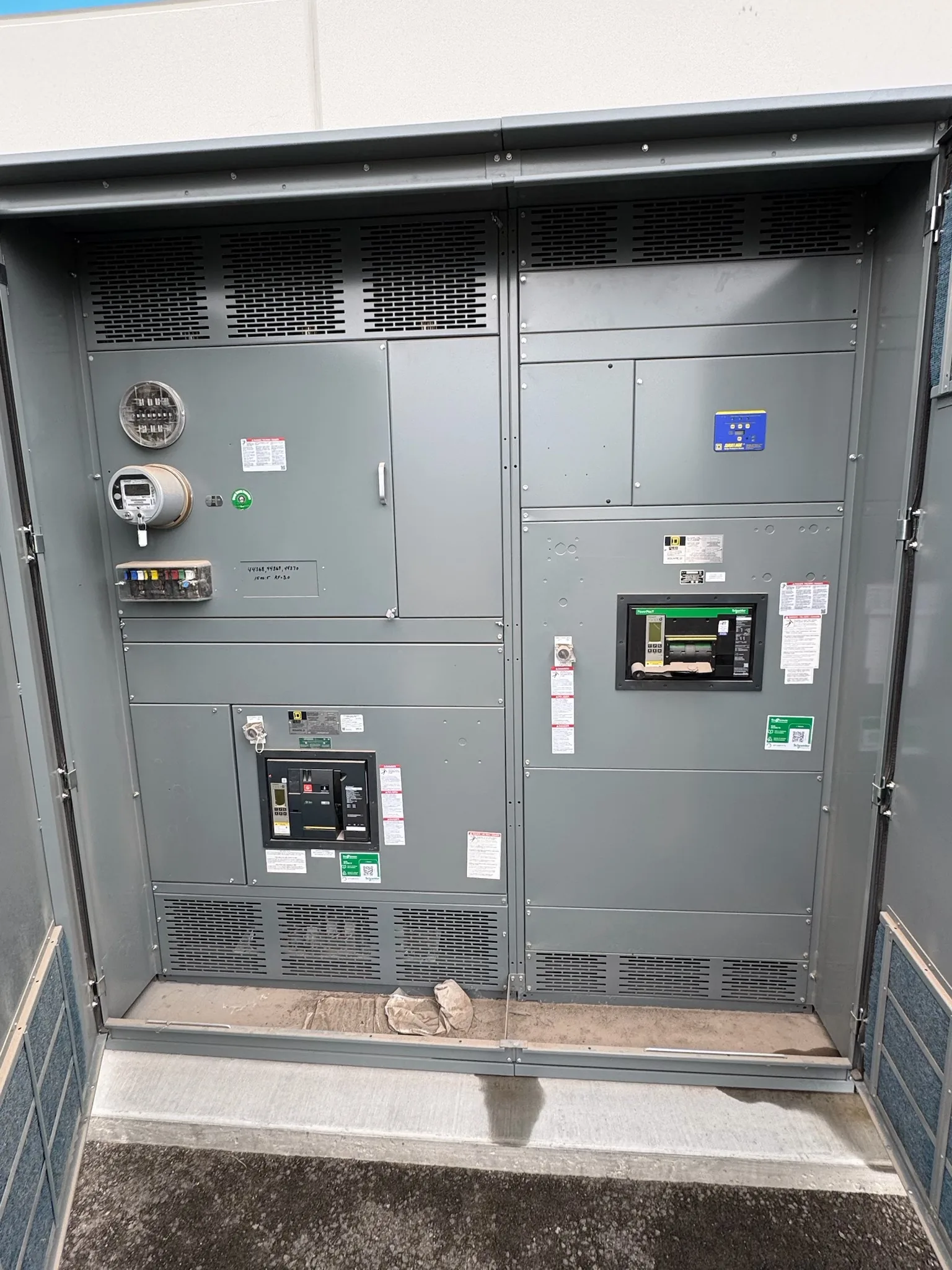
Power distribution, with purpose.
An electrical room delivery path survey tests whether a specified distribution assembly can travel from the receiving point to its intended installation position. It is a project coordination exercise, not simply a doorway measurement: the route may include docks, corridors, elevators, turns, thresholds, ramps and temporary construction conditions. Surveying early can reveal when to revise the equipment layout, delivery sequence or building access plan before drawings and procurement are difficult to change.
Establish the survey inputs before fixing the design
The owner or owner’s representative should identify the equipment function, preferred room location, required operational clearances and project decision makers. The electrical designer supplies the current one-line diagram, preliminary or approved equipment arrangement, system voltage and available fault-current information when known. The manufacturer needs the proposed lineup configuration and specified ratings to develop meaningful outline dimensions; assumptions about section widths, depth, height, shipping splits, doors or removable components must be labeled as preliminary until confirmed for the actual design.
The general contractor or construction manager should provide current architectural plans, structural openings, room elevations, door schedules, loading-dock information and the expected condition of the route at delivery. The team should identify who can verify field dimensions and who controls access, hoisting and temporary openings. For a Dallas–Fort Worth project or a job shipping elsewhere in the United States, the same principle applies: confirm the actual receiving point and route rather than assuming regional familiarity guarantees site access.
Trace the route as a continuous set of constraints
Record clear opening width and height at each doorway, then check the full path for turning space, overhead obstructions, floor transitions and obstructions that may not appear on a plan. A lineup may fit through an opening when viewed face-on yet fail at a corridor turn because its length and depth require a larger swept area. Note whether door leaves, frames, handrails or temporary protection reduce the usable clearance, and distinguish measured dimensions from dimensions inferred from drawings.
The route must also be evaluated for handling and support, not only geometric fit. Ask the project’s qualified structural and rigging professionals to review floor loading, ramps, elevator capacity, lifting points, equipment weight and the proposed movement method. Survey records should flag uncertainty, such as an unverified slab edge or an elevator whose operating restrictions are not yet documented. The survey identifies coordination questions; it does not authorize a lift or establish safe work practices.


Use design milestones to resolve conflicts early
At concept design, compare room location and access routes before architectural openings, walls and major services become fixed. At the equipment-layout milestone, check the actual lineup envelope against the route and the final room arrangement, including required working space and cable or bus connections. Before release for manufacture, reconcile approved submittal dimensions and section breakdown with the construction team’s verified route. A change in breaker arrangement, metering, bus configuration or enclosure details can affect size or weight, so earlier survey conclusions should be revisited when the design changes.
A hypothetical decision illustrates the tradeoff. Suppose a long, factory-assembled switchboard clears the receiving door but cannot make a corridor turn. One option is to revise the room or route, if the building and construction sequence permit it. Another is to evaluate a lineup with shipping splits, which may ease handling but introduce field joining, alignment and connection coordination. A third is to reconsider the equipment arrangement. Each option affects schedule, interfaces and potentially cost; engineering, the manufacturer and the construction team must confirm what is feasible for the specified assembly.
Define handoffs and keep one controlled record
A useful survey package includes a dated route plan, dimensioned sketches or marked-up building drawings, photographs where permitted, a list of measurement locations and notes identifying who supplied or verified each value. It should record doors and openings, turns, floor and overhead constraints, receiving and staging areas, elevator or hoist information, and known construction changes. Mark each item as field-verified, drawing-based, assumed or unresolved so a later reviewer can distinguish evidence from a planning allowance.
Assign a named project role to resolve every open item and set a date for confirmation before the relevant design or delivery decision. The equipment supplier should receive the controlled route record alongside the approved equipment outline and any shipping-section information for the specific order. The contractor retains responsibility for site access and construction coordination, while the owner’s design professionals resolve electrical and building-design questions. Keep superseded sketches identifiable rather than silently replacing them, especially when room layouts or access plans change.
Keep the survey within its technical boundaries
A delivery-path review cannot certify that a room meets electrical code, establish working clearances, approve grounding or ventilation, or select protective-device settings. Those matters depend on the project, adopted codes and authority having jurisdiction and belong with qualified electrical professionals. Structural capacity, rigging plans, traffic control and safe work methods likewise require review by the responsible qualified professionals. No survey drawing should be read as permission for unqualified personnel to handle or work on energized equipment.
The conclusion is limited to the equipment configuration, building information and route conditions available on the review date. It does not guarantee that a delivery will succeed if dimensions are incomplete, construction differs from the record, equipment changes, or temporary obstructions appear. Ratings, short-circuit ratings, component availability, applicable standards and any U.S.-origin requirements must be confirmed for a specific order. UL 891 applies to low-voltage switchboards, not medium-voltage switchgear; any applicable assembly standard or listing must be verified for the exact product.
Prepare a quote request that supports a realistic review
For a quote on new equipment, provide the one-line diagram, project specification, nominal system voltage, required equipment ratings, preliminary lineup arrangement and expected delivery milestone. Include the room plan and the best available route survey, stating which dimensions are verified and which remain provisional. Note any constraints on shipping splits, receiving hours, staging, site access or requested U.S. component origin so they can be reviewed before the design is finalized.
A manufacturer can use those inputs to evaluate a custom build and pursue a shorter lead time as a goal, but timing and configuration depend on the approved design, components and project requirements. Do not treat a preliminary envelope as a guaranteed shipping dimension or a quote-stage review as final engineering approval. The purchaser and project team should confirm the final outline, handling interfaces and route records before release and again if either the equipment design or building conditions change.
Specifications & planning
Review the details that matter for your application. Final specifications and availability should be confirmed for your project.
| Evaluation factor | Record or decision to confirm |
|---|---|
| Opening geometry | Verified clear width and height at each restriction |
| Turns and headroom | Route sketch with swept-space and overhead constraints |
| Handling limits | Structural and rigging review of weights, floors and lifting approach |
| Design status | Equipment outline revision, shipping configuration and unresolved assumptions |